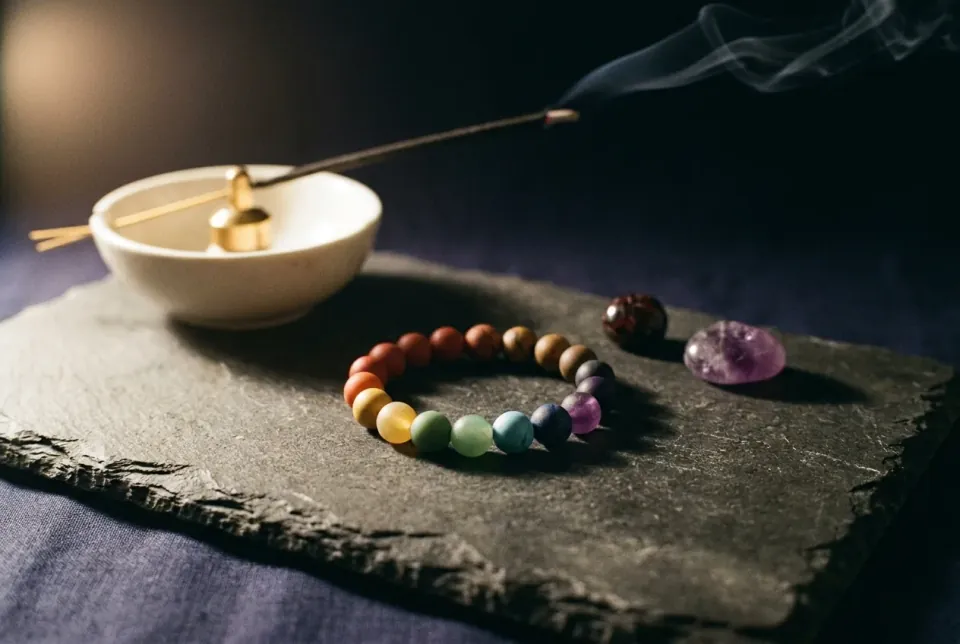
A 7 chakra bracelet means balance across the seven main energy centers. Each colored stone stands for one chakra, in order from root to crown: red for grounding, orange for feeling and creativity, yellow for will, green or pink for love, blue for truthful speech, indigo for intuition, and violet or white for spiritual connection. Wearing all seven together symbolizes alignment of the whole system and gives you a physical reminder to return to it during the day.
A chakra bracelet lives where your hands meet the day: on a keyboard, around a warm cup, against a door handle before you enter a difficult room. A seven-chakra bracelet represents the full current of energy from root to crown. Its colored beads give you a tactile way to notice which center needs attention, then carry that awareness into what you do next.
The stones are not a fixed prescription. Makers choose different gems for the same colors, and a bracelet can hold the seven centers without using one canonical set. Its meaning comes from the chakra map, the intention placed into it and the practice created through touch.
7 chakra bracelet stones and colors chart
Use this chart to read any seven-stone bracelet at a glance. The color and position tell you the chakra; the stone column lists common choices, not a single required set.
| Chakra | Color | Meaning at the wrist | Common bracelet stones |
|---|---|---|---|
| Root (Muladhara) | Red | Grounding, safety, belonging | Red jasper, garnet, red agate |
| Sacral (Svadhisthana) | Orange | Feeling, pleasure, creative flow | Carnelian, orange calcite |
| Solar plexus (Manipura) | Yellow | Will, confidence, direction | Citrine, tiger's eye, yellow calcite |
| Heart (Anahata) | Green or pink | Love, compassion, healthy limits | Green aventurine, jade, rose quartz |
| Throat (Vishuddha) | Blue | Truth, clear speech, listening | Sodalite, blue lace agate, turquoise-colored stones |
| Third eye (Ajna) | Indigo | Intuition, discernment, inner sight | Lapis lazuli, sodalite |
| Crown (Sahasrara) | Violet or white | Spiritual connection, prayer, wider awareness | Amethyst, clear quartz |
Most 7 chakra bracelets string the stones in this rainbow order, so the red root bead sits next to the violet or clear crown bead where the loop closes. Some makers add lava stone, hematite or wooden spacers between the colors. Those spacers are design and grounding accents, not an eighth chakra.
The seven colors are a map, not a stone recipe
The familiar bracelet follows seven energy centers named in sources such as the Yoga Journal chakra guide: root, sacral, solar plexus, heart, throat, third eye and crown. Contemporary chakra jewelry usually arranges their colors in an ascending spectrum. The Art of Living’s chakra guide gives red, orange, yellow, green or pink, blue, indigo, and violet or white as the corresponding colors.
- Root, red: grounding, security, belonging and steadiness. Red jasper, garnet and red agate are common choices. Yoga Journal connects Muladhara with earth, red and the base of the spine.
- Sacral, orange: feeling, desire, pleasure and creative movement. Makers often use carnelian or orange calcite.
- Solar plexus, yellow: will, self-trust, direction and the fire to act. Citrine, yellow calcite and tiger’s eye may appear here.
- Heart, green or pink: love, compassion, grief, reciprocity and the limits that keep love honest. Green aventurine, jade or rose quartz are frequent choices.
- Throat, blue: truth, expression, listening and words spoken at the right time. Blue lace agate, turquoise-colored stones or sodalite may be used.
- Third eye, indigo: intuition, discernment, imagination and inner sight. Lapis lazuli, sodalite and darker blue stones often hold this place.
- Crown, violet or white: spiritual connection, prayer and a wider field of awareness. Amethyst and clear quartz are common.
A list on a product page may differ from these examples without making the bracelet spiritually wrong. Pink can appear at the heart. Clear quartz may take the crown. Tiger’s eye may be placed at the solar plexus, while another maker chooses yellow jade. Ask what the actual beads are before buying, especially if stone identity matters to your practice.
Jewelry has carried protection, rank and symbolic meaning across many periods, as the V&A’s history of jewelry documents. A modern chakra bracelet belongs to a living, contemporary practice rather than one unchanged ancient design. That distinction leaves room for sincere spiritual use without inventing a false lineage for a particular strand of beads.
Why the wrist changes the practice
A necklace brings chakra energy to the chest or throat. A bracelet brings it into motion.
The wrist turns as you cook, write, offer a hand, lift a child or silence a phone. Beads slide and the elastic presses lightly against the pulse. That physical interruption can bring attention back before a feeling becomes an automatic reaction. The bracelet is visible while you act, which makes it especially suited to intentions about conduct: speak clearly, pause before agreeing, stay grounded while moving, create before judging the result.
This is distinct from working up the central channel with a necklace. If you want that body-led practice, the chakra necklace guide follows the seven centers from root to crown. At the wrist, one bead and one next step are often enough.
Left wrist or right wrist?
There is no absolute historical rule that assigns every chakra bracelet to one wrist. The popular left-receives and right-expresses framework is a modern energetic practice. Use it as ritual language, not as a law you can break.
Wear the bracelet on your left wrist when the intention is inward or receptive. You may be practicing rest, receiving support, listening to intuition or allowing love without chasing it. The left side can remind you to notice what is arriving.
Wear it on your right wrist when the intention needs expression. Choose this side for a boundary conversation, creative work, leadership or action that has been delayed. The right wrist keeps the beads close to the hand that signs, makes, gives and changes things for many people.
Your dominant hand, comfort and daily tasks matter too. A bracelet that knocks against a desk or catches at a cuff will pull you out of the practice. Move it to the quieter wrist. You can also switch sides deliberately: receive an intention on the left during meditation, then move the bracelet right when it is time to act.
Set one intention into one bead
A seven-color bracelet can tempt you to address your whole life at once. Begin smaller.
Hold the bracelet between both hands before putting it on. Name the part of the day that needs your care. Perhaps you have to ask for a fairer deadline, enter a crowded gathering or return to a creative project after avoiding it. Choose the bead whose energy belongs to that moment.
Roll that bead once between thumb and finger. Take one slow breath. Give it a sentence that leads to behavior:
Blue, help me say the clear sentence without adding an apology.
Red, keep my attention in my feet while the room gets loud.
Green, let me remain kind without opening a door I need closed.
Then wear the bracelet and touch only that bead when the moment arrives. Afterward, notice what you did, not whether you felt perfectly balanced. Chakra work moves through choice as much as sensation.
For a longer practice, take seven breaths and move one bead per breath. You do not need to recite every meaning. Let the colors pass through your fingers, then stop at the one that catches your attention. Ask, “What action would honor this energy before sunset?” Keep the answer practical.
When the bracelet breaks
First, contain the physical pieces. Pick up loose stones before they roll under furniture or become a hazard. Look at the elastic, cord, knot, crimp and any metal spacers. Stretch cord loses resilience, knots loosen and bead holes can abrade thread. Ordinary wear is a complete explanation, even when the timing feels charged.
Once the pieces are safe, listen to the moment. A break can feel like release after sustained work, saturation after a demanding period or a transition that the old form can no longer carry. It may also be a request for repair. None of these readings is a universal omen, and replacing worn elastic does not undo the bracelet’s meaning.
The context offers more than a ready-made superstition. What were you doing? Which intention had the bracelet held? Did your body feel relieved, startled, sad or simply annoyed? The broader guide to the spiritual meaning of jewelry breaking can help you decide whether to restring, remake or retire the piece.
If you restring it, photograph the bead order first if possible. Replace weak cord rather than tying a failing section back together. A jeweler or experienced bead worker can check sharp drill holes and choose suitable stringing material.
Cleanse a mixed-stone bracelet gently
Seven-chakra bracelets often combine several minerals, dyed beads, elastic and metal components. A cleansing method that suits one stone may harm another part of the piece. When the materials are uncertain, keep the ritual dry.
Wipe the beads and hardware with a soft, dry cloth. Use sound, a spoken intention or a night near a closed window rather than immersing the strand. Keep it out of salt, household cleaner and prolonged moisture. If a maker supplies care instructions for a dyed stone, plated spacer or specific cord, follow those physical limits.
Our guide to cleansing and charging spiritual jewelry explains how to choose a method around the most delicate material in a piece. A thirty-second reset can be enough: hold the bracelet, sound a bell once, turn it slowly in your hands and name the energy you want it to carry next.
Choose stones you can identify and construction you can trust
Start with disclosure. A useful listing names each stone instead of calling the strand “seven healing crystals.” It should also say when beads are glass, composite, dyed or treated. Those materials can still hold personal meaning. Clear labeling lets you choose honestly.
Look closely at construction. Smooth bead holes are kinder to cord. A protected knot, substantial elastic and neatly finished crimps improve the chance that the bracelet survives daily movement. Check the inner circumference rather than relying only on “small” or “medium.” Beads take up space, so a chunky bracelet fits more tightly than a fine chain with the same measured length.
If you want a visible, gemstone-led style, the Daya Jewelry review looks at one brand’s chakra designs, materials and sizing questions. Whatever the maker, choose the strand you will reach for on an ordinary morning. The practice becomes real when a blue bead meets your thumb just before you answer, and the answer changes because you remembered what you meant to protect.