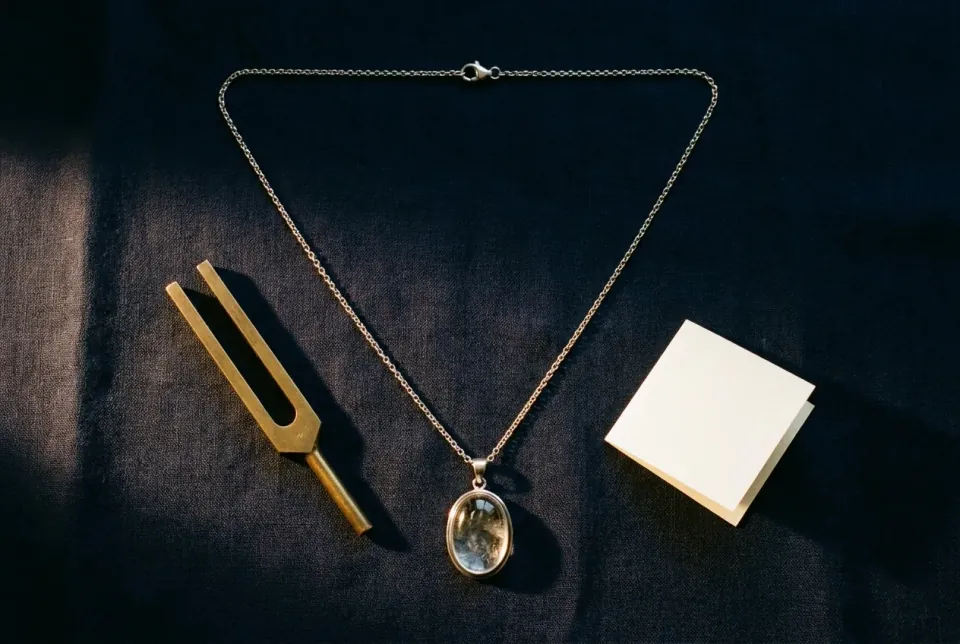
A clear quartz pendant and a tuning fork can look strangely related on the same table. Both catch light. Both feel cool before a hand warms them. Both are sold with the language of vibration. Yet only one arrives with a frequency that can be measured after it is struck.
That difference does not make the pendant empty. It asks us to be precise about the kind of truth we mean.
When someone calls a necklace “high vibration,” they may be describing uplift, clarity, devotion or the sense that the piece helps them return to themselves. Those are experiences and interpretations. They are not readings from an instrument. This guide keeps those two lanes separate, then shows how jewelry can still become a serious spiritual practice without borrowing more certainty from physics than physics gives.
Where vibration entered modern spiritual language
The word did not begin with crystal shops or social media. Nineteenth-century Western esoteric movements already used the language of force, energy and vibration while trying to join religion, nature and the science of their time.
The Theosophical Society was founded in 1875. Helena Blavatsky’s The Secret Doctrine, first published in 1888, presented an occult cosmology that repeatedly compared matter, consciousness, sound and unseen forces. The public-domain text at Project Gutenberg is useful as a primary source for what Theosophy claimed. It is not evidence that those claims became established physics.
Religious historian Catherine Albanese places Theosophy within a longer American metaphysical stream that also includes Spiritualism, New Thought and Christian Science. A University of California, Santa Barbara account of her research describes a tradition preoccupied with mind, flow and energy, often in the service of comfort, healing and transformation.
That vocabulary moved into the loose networks later called New Age. A peer-reviewed history of New Age healing in the journal Religions traces its modern formation through nineteenth-century Theosophy, New Thought and Spiritualism, followed by the human-potential and holistic-health cultures of the 1960s and 1970s. Crystals, subtle energies and self-transformation met inside that broad mixture.
So “raise your vibration” carries a history. It is not an ancient universal formula shared unchanged by every tradition. It is modern spiritual language with several ancestors. Today it often compresses a whole sentence: I want to move from a heavy, reactive state toward one that feels clearer, kinder or more alive.
What frequency means in physics
In physics, frequency is not a rank from spiritually low to spiritually high. It is the number of repeated cycles during a unit of time. The unit hertz means one cycle per second.
A guitar string can oscillate. A quartz crystal in an electronic oscillator can resonate. NIST’s guide to time and frequency explains how clocks count regular cycles and how quartz oscillators use electrically activated crystal vibrations. The rate depends on physical features such as the crystal’s dimensions.
This is real crystal frequency, but it does not provide a spiritual rating system. A measurable resonance needs defined conditions, a mode of excitation and an instrument. It does not tell us that rose quartz emits love, that clear quartz raises consciousness or that one necklace is morally higher than another.
The confusion often begins with a true statement: matter has physical properties, and physical systems can oscillate. Then the language quietly changes. A technical word becomes a promise about mood, destiny, health or character without a testable bridge between them.
You do not need to make that leap. Say what you mean instead.
- Say energizing when a piece helps you feel ready to act.
- Say settling when its weight brings your attention back to the body.
- Say devotional when wearing it renews a relationship with prayer or ritual.
- Say symbolic when the stone represents a quality you want to practice.
- Say traditional when a meaning comes from a named spiritual lineage.
- Say personal when the meaning grew from your own life.
This language is less dazzling than a secret megahertz claim. It is also more useful.
Why the metaphor can still work
A metaphor is not a failed measurement. It is a different tool.
Music gives us an easy example. A room can feel flat before anyone plays, then become vivid when the first chord arrives. We may call the room’s energy higher. We are describing participation, attention and feeling, not reporting that the furniture changed its spiritual frequency.
Jewelry can support a similar shift because it stays close and repeats. A ring appears whenever you reach. A pendant rests where your fingers can find it. A bracelet moves when you turn a door handle. The object can become a threshold between automatic reaction and deliberate response.
This does not prove that the stone transmits an invisible therapeutic force. It explains why the relationship can matter even when the strongest claim remains spiritual or personal. Meaning, touch and repetition can meet in one small object.
The distinction also protects spiritual practice from bad sales tactics. A seller who gives an exact frequency for a gemstone should explain what physical property was measured, under what conditions, with which instrument and why that result supports the promised outcome. Without those details, the number is decoration wearing a lab coat.
Choose spiritual jewelry for meaning, craft, material honesty and the practice you will actually keep. Our guide to choosing spiritual jewelry covers comfort, symbolism and construction. A dramatic energy claim cannot repair a weak clasp, an undisclosed alloy or a stone that was sold under the wrong name.
Use the piece as a sensory anchor
There is a grounded practice hiding inside the word vibration: use sensation to return to the present, then choose the state you want to strengthen.
Clinical grounding exercises are not the same as crystal healing. Still, they show why a wearable object can be practical. A Hull University Teaching Hospitals NHS Trust grounding guide uses the five senses to reconnect with the present and notes that some people carry a pebble or stress ball as a reassuring object. Touch, temperature and texture give attention somewhere concrete to land.
Jewelry can fill that narrow role. It remains spiritual when you give the object a chosen meaning. It remains honest when you do not promise that the material treats illness. Spiritual jewelry may complement care and daily self-regulation, but it does not replace medical or mental-health support.
Choose one quality for seven days. Make it plain enough to recognize in conduct: steadiness, courage, patience, tenderness or clear speech. Then choose one piece that is safe and comfortable to touch.
Use this four-part return:
- Touch. Place two fingers on the piece. Notice whether it feels cool, warm, smooth, faceted, light or heavy.
- Breathe. Let one exhale last a little longer than the inhale. Do not force a special state.
- Name. Say the quality once: “Steadiness,” or “Clear speech.”
- Act. Take one visible step that matches it. Put both feet down. Read the message again. Ask the direct question. Wait before answering.
Keep the sequence under thirty seconds. The aim is not to escape every difficult feeling. It is to create a small space in which choice can return.
Build a seven-day frequency practice
Begin by physically cleaning the piece according to its materials. If you also want a ritual clearing, use a dry and material-safe method from our guide to cleansing and charging spiritual jewelry. Do not place finished jewelry in salt or water simply because a spiritual instruction treats all stones alike.
Write one sentence that translates “high vibration” into behavior.
When I touch this pendant, I soften my shoulders and speak without rushing.
When I see this ring, I return to the work in front of me.
When this bracelet moves, I remember that kindness includes a boundary.
Each morning, hold the piece for one minute. Notice three physical facts about it. Read the sentence aloud. Then put it on and name the first moment when you expect to need the cue.
During the day, use the four-part return at that moment. Do not wait for mystical intensity. The useful repetition may happen before opening email, entering a meeting, checking an account or answering a difficult call.
Each evening, remove the jewelry and write one line: Did the cue change what I did? Record the action, not an omen. “I paused before replying” gives you more information than “the crystal felt powerful.”
After seven days, decide what the piece now means. Keep the practice if the cue helped. Change the sentence if it was vague. Retire the experiment if touching the jewelry became another demand. No stone requires your loyalty to a method that makes you less present.
Let the claim become smaller and the practice deeper
The pendant and the tuning fork still share a table, but they do not need to prove the same thing. Strike the fork, and an instrument can measure cycles. Touch the pendant, and you can notice what meaning, memory and repetition invite you to do next.
That is enough. “High vibration” becomes most honest when it stops pretending to be a laboratory result and starts naming a direction. The jewelry does not need a secret frequency. It needs a clear purpose, a truthful story and a life in which you remember to touch it.