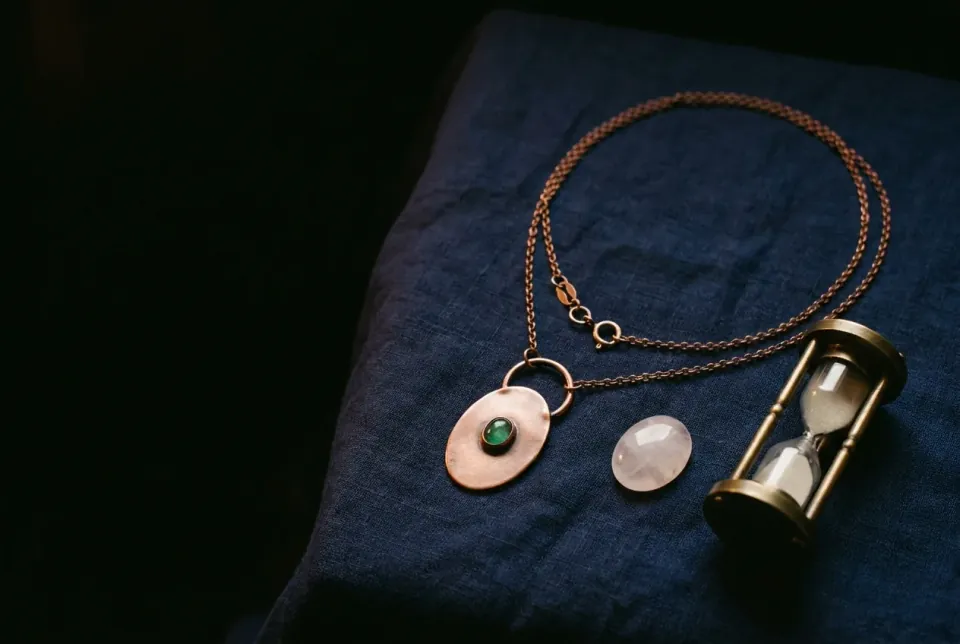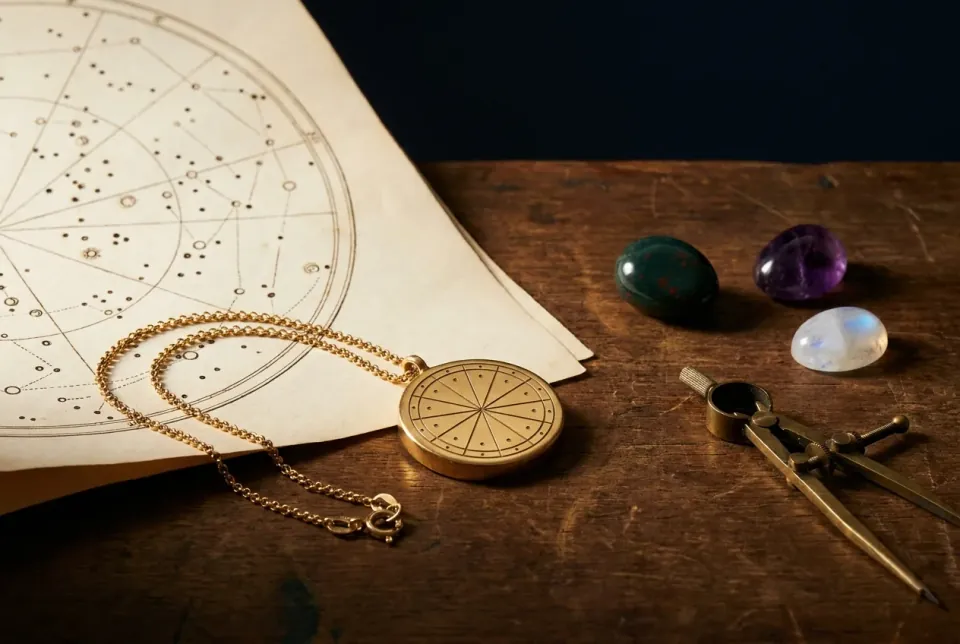

A dark ring rests on a folded lease. Beside it, a pen waits above the line where a name must go. The jewelry cannot decide whether the apartment is affordable, whether the city is right or whether staying would be the braver choice. It can only make the moment harder to avoid.
That is a useful image for the first Saturn return. In astrological practice, this period is often described as a threshold of consequence. Work, partnership, money, home and time begin to ask for decisions that cannot remain interesting possibilities forever. Some structures deepen. Others show their cracks.
A Saturn talisman should not promise that the threshold will be painless. Its purpose is smaller and more demanding: to hold one commitment where you can see and touch it. This guide separates the planet’s actual orbit from astrological interpretation, traces the older material correspondences and turns them into a safe, practical piece you can wear through the work.
What returns when Saturn returns
Astronomically, Saturn takes about 29.4 Earth years to complete one orbit of the Sun, according to NASA’s Saturn facts. Astrology maps the planets against a birth chart. A Saturn return occurs when Saturn reaches the same zodiacal position it occupied at a person’s birth.
The first return therefore gathers around the late twenties, although it is not confined to one birthday. Saturn can cross the natal degree more than once because its apparent retrograde motion changes the exact sequence. A birth chart and current ephemeris are needed for precise dates. An online age range is only an estimate.
Astrodienst’s Saturn reference describes the first return at about age 29.5 as a stage associated with maturity, responsibility and concentration on what is essential. That is an astrological interpretation, not an astronomical force proven to cause a job change, breakup or crisis. People experience their late twenties differently, and no chart can erase money, health, family, culture or chance.
Still, the symbolic frame can be useful. Saturn gives a name to limits, duration and work that becomes visible only after repetition. The return asks less, “What do I want to become?” than “What am I willing to keep doing when novelty leaves?”
Why Saturn is not only punishment
Popular astrology often gives Saturn the role of a grim examiner. Lose the job. End the relationship. Face the bill. The older tradition does contain severe language, but reducing the planet to punishment misses half its grammar.
Saturn governs boundaries because a boundary gives form. A deadline limits time, yet it can finish a book. A budget limits spending, yet it can make a move possible. A vow removes some choices, yet it can deepen one relationship. Discipline is not automatically virtuous, and hardship is not proof of cosmic favor. But chosen limits can protect what matters.
This is why the hardest years can also become good years. “Best” does not mean happiest. It means that a structure becomes honest enough to carry real weight. You leave a role built for approval. You choose a place and begin tending it. You admit that a dream needs training, money and Tuesdays, not only desire.
Use astrology here as a reflective practice, not a verdict. If you are anxious, depressed or in danger, jewelry and chart work do not replace practical support, medical care or professional help.
Lead, onyx and the old correspondence table
Renaissance astrology organized the world through correspondences. Planets, metals, stones, plants, colors and temperaments could belong to one symbolic family. The Stanford Encyclopedia of Philosophy places Heinrich Cornelius Agrippa’s Three Books of Occult Philosophy within the Neoplatonic and Hermetic thought of its period. His tables are historical sources, not material science.
In Book I, Chapter 25, Agrippa names lead as Saturn’s chief metal. He also includes gold because of its weight. His stones include onyx, sapphire, brown jasper, chalcedony, lodestone and, in the old translation’s broad phrase, dark, weighty and earthy things.
The symbolism is clear. Lead is heavy, slow and dull in color. It feels like gravity made metal. Do not turn that symbolism into a wearable instruction. Lead is toxic, and direct-contact jewelry should not use it.
Pewter often appears as a modern substitute, but the word alone does not guarantee composition. Encyclopaedia Britannica’s pewter history notes that older pewter could contain substantial lead, while modern pewter is commonly a tin alloy with antimony and copper. If you choose pewter, require an explicit lead-free specification from the maker. “Vintage pewter” is not enough.
Safer dark-metal choices include oxidized sterling silver, stainless steel, titanium or a verified lead-free pewter. The metal does not need to imitate lead chemically. It needs to survive repeated wear and fit the practice without harming the wearer.
Onyx offers the clearest line to Agrippa’s list. Choose a well-set cabochon with no loose movement at the bezel or prongs. Black spinel, smoky quartz or dark sapphire can carry a similar visual weight, but do not present them as entries in this exact historical list.
Garnet is common in contemporary Saturn-return jewelry because its deep red can suggest endurance, blood and work carried through time. It has a long independent jewelry history: the Gemological Institute of America records red garnet in Egyptian necklaces, Roman signet rings and later European jewelry. Agrippa’s Saturn chapter does not name garnet. Choose it as a modern personal association, not as proof of one universal Saturn tradition.
Choose a commitment piece, not a crisis purchase
A Saturn return can make every decision feel permanent. That is exactly when expensive symbolic buying can become a substitute for the decision itself. Pause before ordering.
First, name one commitment that remains within your control. Keep it concrete enough to practice for a year.
- I will make one payment toward my debt every month.
- I will give my craft three protected hours each week.
- I will tell the truth sooner in close relationships.
- I will keep one evening free from work.
- I will finish the qualification I already chose.
- I will leave situations that require me to become smaller.
Avoid promises about outcomes you cannot command. “I will become a director this year” depends on other people. “I will complete the portfolio and apply for twelve suitable roles” gives the talisman work it can actually hold.
Then choose the form. A ring stays visible while you sign, type and spend. A bracelet is easy to touch before an automatic reaction. A pendant can remain private under clothing and rest near the body’s center. The practical checks in our guide to choosing spiritual jewelry matter here: confirm metal, measurements, setting, clasp, return terms and care.
Do not choose a fragile piece to represent endurance. Check whether a ring suits daily hand use. Check whether a dark finish is a surface treatment that will change with friction. Ask whether a stone is natural, treated, synthetic or imitation. Symbolic seriousness does not excuse vague product information.
Dedicate the piece to one year of work
You do not need a technically elected astrological talisman for this practice. A formal planetary election belongs to a more exact system. This is a personal dedication shaped by Saturn’s themes of time, limits and responsibility.
Set aside thirty minutes on a Saturday, the day traditionally associated with Saturn. Prepare:
- the jewelry;
- one blank card and a pen;
- a dark or bone-white cloth;
- a clock or hourglass;
- the document, tool or object connected to your commitment.
Use a budget page for debt work, a notebook for study, a key for home care or a calendar for protected time. Keep the scene plain. Saturn does not need decorative excess.
Inspect the jewelry first. Check the clasp, stone, band and edges. Clean it only with a method suitable for its exact materials. The material-safe options in our cleansing and charging guide are more useful than forcing every stone into salt, smoke or water.
Write the commitment in one sentence. Beneath it, write the smallest repeated action that proves it. Add a review date one year ahead.
Turn the hourglass, or set a timer for three minutes. Sit without revising the promise. Notice the part that feels heavy. Ask whether the weight comes from honest effort or from a commitment that should never have been yours. Saturn practice is not obedience to every burden.
When the time ends, place the jewelry over the card and say:
I give this promise a form. I accept the limit that protects it, the work that builds it and the truth that may change it. Let this piece return me to the next honest action.
Put on the jewelry. Complete the first action immediately, even if it takes only five minutes. Schedule the transfer. Open the document. Send the inquiry. Block the weekly hours. The action consecrates the promise more clearly than elaborate language.
Wear it through the return
Use the piece as a cue, not an oracle. Touching the ring before checking your account can interrupt avoidance. Fastening the pendant before a study session can mark protected time. Removing the bracelet at the end of work can defend a boundary.
Review the card on the first Saturday of each month. Record one piece of evidence: a payment made, a session completed, a conversation held or a boundary kept. Do not manufacture a dramatic lesson. Saturn’s material is often boring. That is why it can become a life.
If the commitment fails repeatedly, inspect the structure before blaming your character. Is the action too large? Is the calendar unrealistic? Does the promise depend on another person’s cooperation? Does the jewelry irritate your skin or interfere with work? Change the method while keeping the honest purpose.
If the commitment itself becomes harmful, release it. A vow to remain in an unsafe workplace or relationship does not become sacred through suffering. Remove the piece, cross out the sentence and write what the experience proved. Responsibility includes ending what should not continue.
For a different planetary practice centered on reciprocity and beauty, our Venus talisman guide uses timing and material correspondences without treating them as physical laws. The contrast is useful: Venus asks what allows connection to flourish; Saturn asks what lets a promise endure.
Let the ring meet the signature
Return to the dark ring on the lease. It does not say sign or leave. It asks for the figures, the terms and the truth about what the next year requires. Then it waits.
That is enough work for a talisman. The planet supplies a language of time. The metal supplies weight. The commitment becomes real through the next transfer, practice hour, honest sentence or closed door. Years later, the scratches on the piece may record no miracle at all. They may record something better: that you stayed present long enough to build a life you could stand inside.