
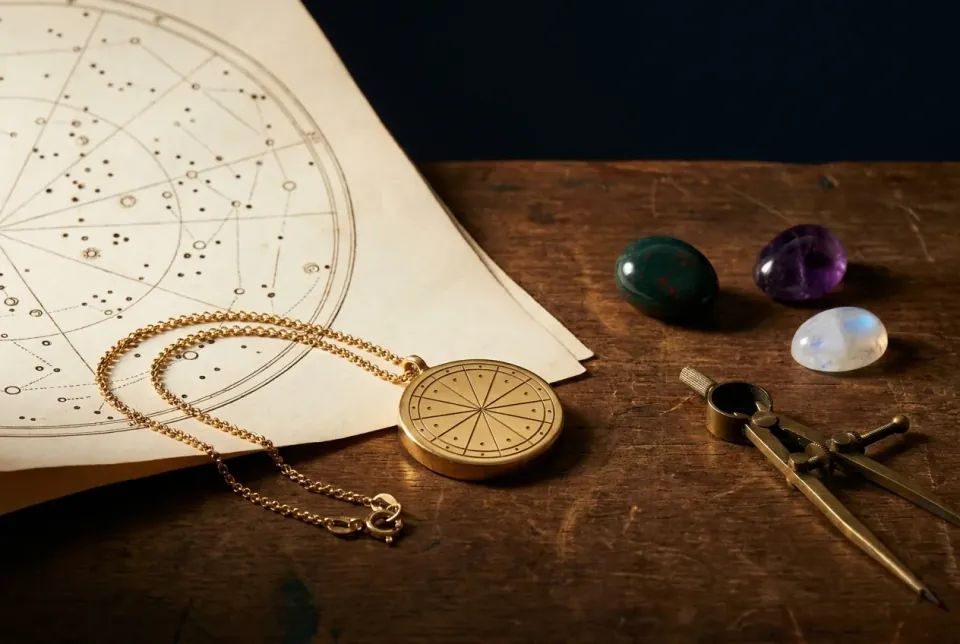
A jeweler once showed me two trays labeled for Pisces. One held amethyst, the February birthstone. The other held aquamarine, the March birthstone. A card beside them named moonstone as the intuitive choice for Pisces, while a third chart online insisted on bloodstone. All four could be defended. None was the single original answer.
The confusion begins with a small trick of language. We use birthstone for a gem assigned to a calendar month and for a stone assigned to an astrological sign, even though a sign crosses two months. Then contemporary crystal practice adds stones by color, element, planetary ruler, or desired quality. The lists look contradictory because they are answering different questions.
This guide separates those systems. It gives one documented early twentieth-century zodiac list, a contemporary practice example for each sign, and the planetary ruler that explains part of the symbolism. The table is a map, not a decree.
Birthstones and zodiac stones are different systems
The modern American birthstone list is a jewelry-industry standard organized by calendar month. Jewelers of America dates its official list to 1912, when the American National Retail Jewelers Association, its predecessor, established it. GIA likewise presents birthstones month by month, from garnet in January to the choices offered for December in its current birthstone guide.
That does not mean people invented meaningful gems in 1912. Gem lore, talismanic stones, religious stone lists, and jewels associated with times of year are much older. What 1912 supplied was a consistent commercial calendar for American jewelers.
Even the monthly list has layers. The International Gem Society’s modern and traditional chart places aquamarine beside March on the modern side and bloodstone on the traditional side; August can mean peridot or spinel in the modern column and sardonyx in the traditional one. “Traditional” here names an inherited monthly list, not one unchanged system from antiquity.
A zodiac stone begins elsewhere. It belongs to Aries, Taurus, Gemini, and the rest of the twelve-sign wheel. Britannica traces the division of the zodiac into twelve 30-degree signs to Babylonian astronomy around 500 BCE, while also noting that the astrological signs no longer align neatly with the astronomical constellations because of precession. Zodiac gemstones are later layers of correspondence placed onto that wheel.
So a person born on March 25 can reasonably encounter aquamarine for March, diamond for April-facing Aries, bloodstone in a zodiac list, and carnelian in a modern crystal guide. The labels are not synonyms.
The twelve signs, with the layers named
The older list below comes from George Frederick Kunz’s 1913 book, The Curious Lore of Precious Stones. Kunz printed bloodstone for Aries, sapphire for Taurus, agate for Gemini, emerald for Cancer, onyx for Leo, carnelian for Virgo, chrysolite for Libra, beryl for Scorpio, topaz for Sagittarius, ruby for Capricorn, garnet for Aquarius, and amethyst for Pisces.
That is a documented historical list, but not the historical list. In the same chapter, Kunz reproduced an old Spanish list that disagreed with it almost sign by sign. The contradiction is part of the record.
The contemporary example column is our editorial practice map. It follows common modern crystal language and the sign’s element or ruler. It does not claim ancient authority. The ruler column uses the Western astrological framework described by the Faculty of Astrological Studies; modern co-rulers are shown after the classical ruler where relevant.
| Sign | Kunz’s 1913 zodiac list | Contemporary practice example | Planetary ruler |
|---|---|---|---|
| Aries | Bloodstone | Carnelian for directed action | Mars |
| Taurus | Sapphire | Rose quartz for receptive steadiness | Venus |
| Gemini | Agate | Citrine for clear, lively expression | Mercury |
| Cancer | Emerald | Moonstone for rhythm and emotional listening | Moon |
| Leo | Onyx | Sunstone for visible, generous creativity | Sun |
| Virgo | Carnelian | Moss agate for patient, useful tending | Mercury |
| Libra | Chrysolite | Lapis lazuli for truth within relationship | Venus |
| Scorpio | Beryl | Obsidian for depth, boundaries, and release | Mars, with Pluto as modern co-ruler |
| Sagittarius | Topaz | Turquoise for movement and wide horizons | Jupiter |
| Capricorn | Ruby | Garnet for durable commitment | Saturn |
| Aquarius | Garnet | Amethyst for spacious thought | Saturn, with Uranus as modern co-ruler |
| Pisces | Amethyst | Aquamarine for permeability with calm | Jupiter, with Neptune as modern co-ruler |
Notice what the table refuses to do. It does not call rose quartz the “true” Taurus stone or declare that onyx belongs only to Leo. Stones have crossed signs, planets, months, languages, and markets for centuries. A clean chart is useful for orientation. It becomes dishonest when its neatness is mistaken for universal agreement.
Why the lists disagree
Four forces keep rearranging the stones.
Different source traditions. Kunz gathered lapidary, religious, astrological, and folkloric material that did not resolve into one sequence. His chapter preserves several incompatible correspondences rather than hiding them. A list drawn from one European lapidary will not necessarily match a later list shaped by Arabic, Indian, or commercial sources.
Month and sign overlap. Every tropical Sun sign spans parts of two calendar months. Pisces crosses February and March, which makes both amethyst and aquamarine easy modern associations. Leo crosses July and August, inviting ruby, peridot, spinel, and sardonyx into nearby lists. Sometimes a so-called zodiac chart is simply the monthly birthstone calendar shifted onto signs.
Planetary symbolism. Astrologers associate signs with ruling planets, then associate planets with colors, metals, stones, and qualities. The Faculty of Astrological Studies’ introduction describes Mars through heat, sharpness, iron, and red; Venus through beauty, value, copper, and green; the Moon through silver, feeling, and ritual. A modern practitioner may therefore choose red carnelian for Mars-ruled Aries or a soft heart stone for Venus-ruled Taurus without consulting a fixed zodiac-stone table.
The purpose of the choice. One list aims to strengthen a sign’s familiar qualities. Another offers a balancing stone. Leo might receive sunstone to encourage radiance, or onyx to give that radiance structure. Gemini might receive citrine for quick expression, or agate for steadiness. Opposite recommendations can both make sense once the intention is stated.
This is why “What is the stone for my sign?” is the article’s one real question, but it needs an instruction beneath it: Name the practice first.
Read the ruler before buying the stone
A planetary ruler can make a correspondence easier to understand than a memorized chart.
Mars rules Aries in classical Western astrology, so red, iron-rich, activating stones often gather around Aries. Venus rules Taurus and Libra, but the two signs do not need identical jewelry. Taurus may approach Venus through touch, patience, and material beauty. Libra may approach Venus through proportion, exchange, and harmony. Mercury rules both Gemini and Virgo, yet quick conversation and careful discernment are different Mercurial expressions.
The outer planets add another fork. Traditional astrology gives Scorpio to Mars, Aquarius to Saturn, and Pisces to Jupiter. Many modern astrologers also use Pluto, Uranus, and Neptune for those signs. Neither framework automatically determines a gemstone. It tells you which symbolic vocabulary a list is using.
If a seller calls a stone “the ancient Aquarius crystal” but builds the explanation entirely around Uranus, the wording has collapsed two periods. Uranus was not known to ancient astrologers. The stone may still feel right for the practice. The history needs a cleaner label.
Choose a zodiac stone without pretending there is one answer
Begin with the system, then choose the object.
- Name the layer. Decide whether you want your calendar-month birthstone, the older Kunz correspondence, a planetary stone, or a contemporary crystal pairing. Write that choice down.
- Name the placement. Your Sun sign is the simplest starting point. In a contemporary practice, the Moon sign can hold emotional or home ritual, while the rising sign can mark how you enter situations. A full chart is not required to wear meaningful jewelry.
- Name one purpose. Choose support or balance. An Aries seeking momentum may choose carnelian; an Aries learning to pause may prefer amethyst. The intention explains the choice better than a claim of cosmic exclusivity.
- Check the actual jewel. A symbolic stone still needs an honest identity, secure setting, suitable hardness, and wearable scale. Our guide to choosing spiritual jewelry covers the construction questions that a zodiac chart cannot answer.
- Begin a repeatable practice. Clean the piece using material-safe guidance, then hold it for three breaths and state the quality it will recall. The guide to cleansing and charging spiritual jewelry offers methods that do not require soaking or sunlight.
For a water-sign practice built around lunar rhythm, the moonstone necklace guide separates the stone’s optical structure from its contemporary symbolism. That separation is the model to keep: mineral fact, inherited lore, and personal use can sit together without being blurred.
Let the disagreement become part of the practice
Return to those two Pisces trays. Amethyst carries one line through February and through Kunz’s Pisces list. Aquamarine carries another through March and the sea-colored language modern practice gives Pisces. Moonstone enters through lunar intuition rather than a standardized Pisces inheritance. Bloodstone arrives from a different historical monthly scheme.
You do not have to force the trays into one answer. Choose the lineage you can name and the stone you will actually wear. The honest sentence is not “This is the only stone for me.” It is quieter: “This is the correspondence I am practicing now.”