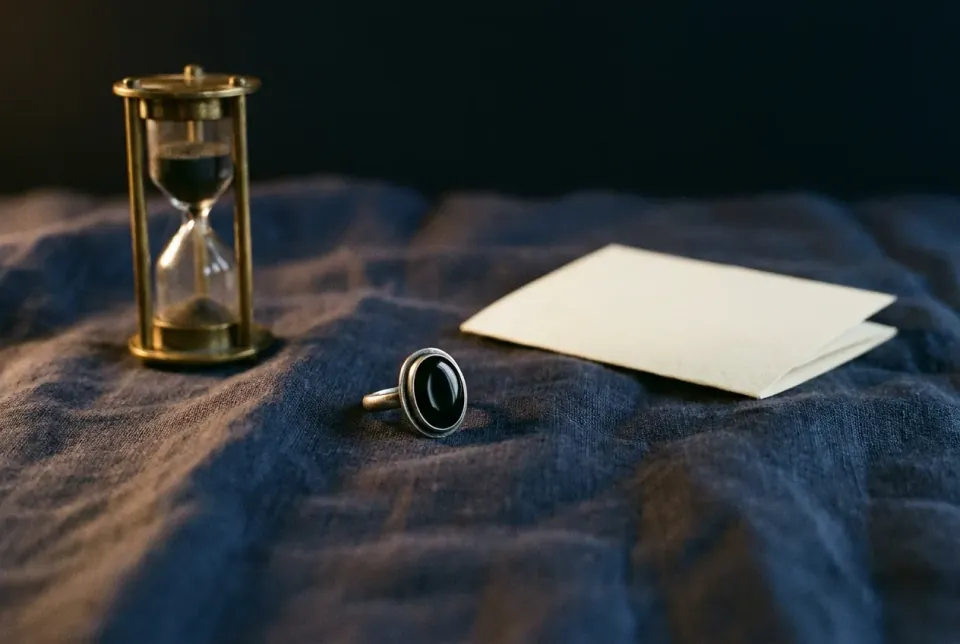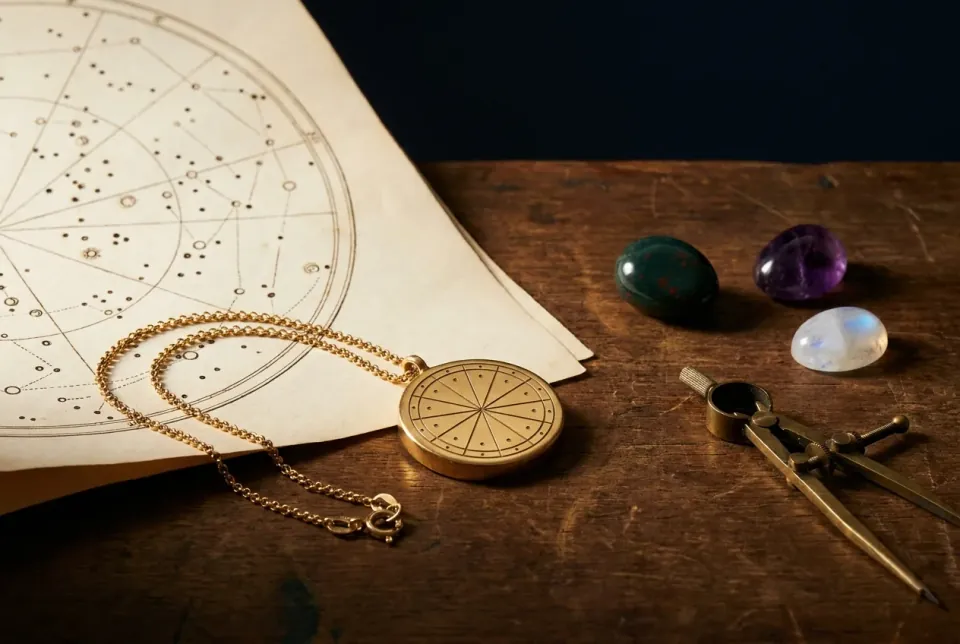
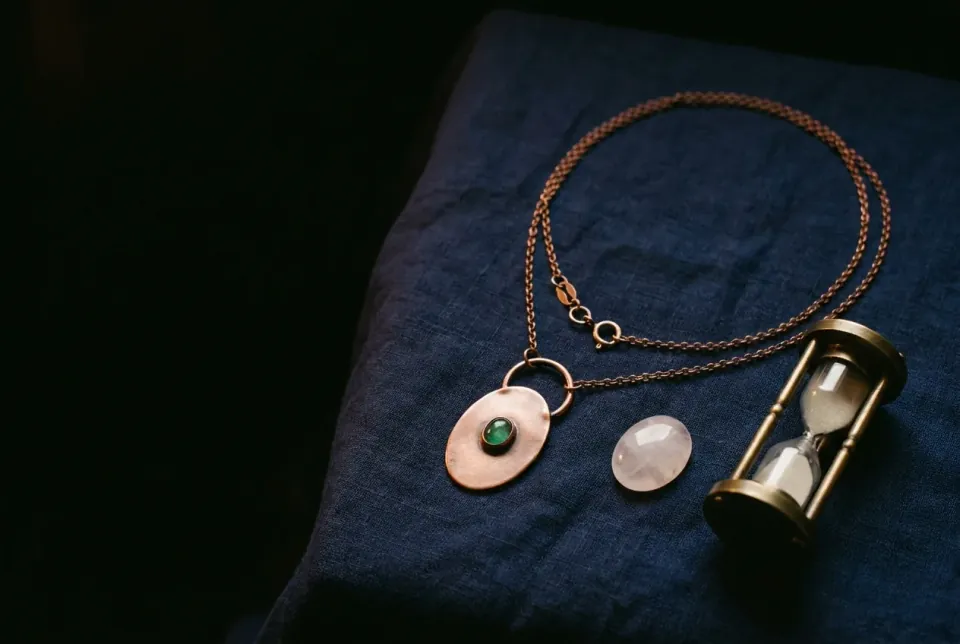
A small copper pendant rests on dark cloth beside a clock. Its surface is warm rather than bright, and the green stone at its center catches only a narrow line of light. The clock matters. In planetary talisman work, the material and the moment are part of the same sentence.
Love magic can become careless when it begins with a person’s name. This practice begins elsewhere: with the quality of relationship you are willing to create and receive. Mutual attention. Pleasure without performance. Affection with room for an honest no.
The ritual below follows the broad logic of Western astrological magic: choose materials associated with Venus, work during a Venus time and dedicate the finished piece to a Venusian purpose. It also draws a firm boundary. A talisman may support intention, self-knowledge and brave action. It cannot replace therapy, communication or consent, and it should never be used as a claim over another person.
What a planetary talisman is meant to do
A planetary talisman is an object made or dedicated to carry the qualities assigned to one of the traditional seven planets. In Renaissance natural magic, the world was understood through correspondences. A planet, metal, stone, color, plant and hour could belong to one family of meaning.
That framework is historical astrology, not modern astronomy. The physical planet Venus is a hot world with a dense atmosphere, sulfuric-acid clouds and a slow retrograde rotation, as Royal Museums Greenwich explains. The planet received its Roman name from the goddess of love and beauty. Astrological Venus grew from that symbolic lineage, not from the chemistry of the planet’s surface.
Renaissance thinkers treated correspondences as active relationships. The Stanford Encyclopedia of Philosophy’s account of Cornelius Agrippa places his Three Books of Occult Philosophy within a Neoplatonic and Hermetic system. Agrippa’s work joined material correspondences, celestial timing and religious philosophy. A talisman was therefore not merely jewelry with a planet engraved on it. It was an object prepared to meet a chosen quality at an elected moment.
You do not need to accept the Renaissance model as physics to practice inside its spiritual grammar. The talisman can still gather attention around beauty, reciprocity, delight and values-led relationship. Timing gives the act a threshold. Repetition gives the object a life in practice.
For a practice centered on limits, responsibility and one promise carried through the late twenties, our Saturn return commitment-piece guide uses the same historical care with a different planetary language.
Choose the form of love before the jewelry
Write one sentence before choosing the piece. Keep it within your own choices.
Try one of these:
- I welcome love that is mutual, honest and freely chosen.
- I meet tenderness without abandoning discernment.
- I make room for pleasure, friendship and creative joy.
- I speak desire clearly and receive the answer with grace.
- I treat my body and heart as worthy of patient care.
Do not write a specific person’s obedience into the sentence. “Alex leaves their partner and chooses me” is not a love intention; it is an attempt to write over other lives. “I recognize available love and answer it openly” keeps your will intact without pretending you own anyone else’s.
Choose what kind of Venus work the sentence names. Romantic partnership is only one possibility. Venus can hold friendship, art, beauty, sensual presence, reconciliation with your own body and the ability to receive pleasure without turning it into debt. The right form changes the right piece.
A ring suits a promise you want to see while acting. A bracelet makes an easy touchstone before sending a message or entering a social room. A pendant rests near the heart and can remain private under clothing. Our guide to choosing spiritual jewelry can help you match the form, fit and material to ordinary wear rather than ceremony alone.
Copper, emerald and the problem with fixed lists
Contemporary Venus work often begins with copper. Its warm color, softness and long symbolic link with Venus make it a familiar choice. Yet historical lists do not all say the same thing.
In Book I, Chapter 28 of Agrippa’s Occult Philosophy, the 1651 English translation names silver and both yellow and red brass among Venus metals. It does not simply give the modern formula “Venus equals copper.” That difference is useful. Correspondence tables are inherited traditions, not laws of nature, and translations, alloys and later practice can shift the vocabulary.
Choose copper if you already work with it as Venus’s metal and your skin tolerates it. Expect unfinished copper to darken and sometimes leave a green mark. Choose brass for its golden warmth, but ask what the alloy contains. Choose sterling silver when you want Agrippa’s explicit correspondence and a cooler piece. If you have a metal sensitivity, material safety outranks symbolic purity.
Agrippa’s Venus stone list is broad: beryl, chrysolite, emerald, sapphire, green jasper, carnelian, lapis lazuli and coral appear among other fair, white, green and varied stones. Emerald is the clearest choice when you want a direct line to that text. The Gemological Institute of America’s emerald history identifies emerald as the green variety of beryl and traces its long cultural fascination. Emerald can also contain inclusions and needs care, so inspect the setting and follow the seller’s cleaning guidance.
Rose quartz belongs to contemporary crystal practice rather than Agrippa’s Venus list. That does not make it false or forbidden. It makes the claim narrower. Choose rose quartz for a modern tenderness or self-love practice. Choose emerald when lineage to a Renaissance correspondence matters. Choose no stone at all when the metal and the ritual already say enough.
Avoid coral unless you know its lawful, ethical and material provenance. A historical appearance in a source is not a shopping instruction. Vintage, inherited and imitation materials may carry the color without creating new demand for wildlife material.
Find a Venus hour without pretending the clock is ancient
Friday is the traditional day of Venus. The first planetary hour after local sunrise on Friday belongs to Venus. Later Venus hours return through the repeating sequence of Saturn, Jupiter, Mars, Sun, Venus, Mercury and Moon.
Planetary hours are not fixed sixty-minute blocks. Agrippa’s Book II discussion of planetary hours describes a common method that divides the time from sunrise to sunset into twelve equal daytime parts, then divides sunset to the next sunrise into twelve nighttime parts. Day and night hours therefore change length with season and location.
For the simplest practice, use the first hour after sunrise on Friday. Find Friday’s local sunrise and the same day’s sunset from a reliable weather or astronomy service. Calculate the daylight length, then divide it by twelve. If sunrise is 7:00 and sunset is 19:00, each daytime planetary hour is sixty minutes. The first Venus hour runs from 7:00 to 8:00.
If sunrise is 7:30 and sunset is 17:30, daylight lasts ten hours, or 600 minutes. Divide 600 by twelve. Each daytime hour lasts fifty minutes, so the first Venus hour runs from 7:30 to 8:20.
You can use a reputable planetary-hour calculator, but enter your correct location and check that it uses local sunrise and sunset. Do not confuse the planet’s astronomical visibility with its planetary hour. Venus does not need to be visible in the sky for a Friday Venus-hour ritual.
Traditional astrological magic can use more exact elections. Agrippa also discusses planetary dignity and rising signs, and his chapter on images of Venus gives several highly specific image and timing combinations. Those instructions belong to a technical historical system. A personal dedication ritual does not need to reproduce an erotic Renaissance image, calculate every dignity or claim the authority of a formally elected talisman.
Consecrate the talisman on Friday
Set aside twenty minutes within the Venus hour. Prepare:
- the jewelry;
- a clean bone-white or natural cloth;
- a small bowl of fresh water that will not touch the jewelry;
- one flower, fresh or dried;
- your written intention;
- an unlit candle, if you want a marker for the beginning.
Check the clasp, jump rings, setting and edges in good light. Wipe the piece with a soft dry cloth unless its maker gives another safe method. Do not soak copper, plated metal, emerald, glued settings or unknown materials. Use the material-safe options in our guide to cleansing and charging spiritual jewelry when the piece needs an energetic clearing first.
Place the jewelry on the cloth. Put the water and flower beside it. They represent receptivity and beauty; they do not need to touch the piece.
Take three easy breaths. Read your sentence once. Then say:
Venus, keeper of beauty, pleasure and mutual regard, let this piece return me to love that is freely given and freely received. Let desire keep its honesty. Let tenderness keep its boundaries. Let beauty become attention, and attention become care.
Lift the piece. Notice its actual weight, temperature and construction. Name three behaviors that would make the intention visible. You might accept a sincere invitation, state what you want without disguise and leave when an answer is not mutual.
Pass the jewelry once over the bowl without touching the water. Pass it once near the flower. Put it on and speak your intention three times. On the final repetition, place one finger on the piece and name the first real action you will take.
Leave the flower on the cloth until the Venus hour ends. Pour the water onto soil or down the sink. Keep the written sentence with the jewelry overnight, then move it somewhere private.
Wear it as a practice of reciprocity
For seven Fridays, put on the talisman during any Venus hour you can meet without strain. Read the intention once. Then choose one Venusian action that does not depend on controlling another person.
Make something beautiful. Wear a color that lets you feel present. Tell a friend what you value in them. Practice receiving a compliment without immediately returning one. Ask for the kind of date you actually want. Give a clear no before resentment has to give it for you.
Touch the piece when attraction makes you abandon your own information. The talisman should not turn every coincidence into a sign that a person is destined for you. Let it ask a cleaner question: is this connection reciprocal in words, time and conduct?
If the answer is no, the work may be release rather than attraction. Remove the jewelry. Place it on its cloth. Thank the desire for showing you what you want, then return your attention to relationships where choice moves in both directions.
You can rededicate the piece after a breakup or a major change. Clean it safely, wait until the first raw urgency has eased and write a new sentence. A Venus talisman for partnership can become a talisman for friendship, art or self-trust. The object serves the living practice, not the other way around.
Let beauty keep its boundary
The pendant beside the clock is still only metal and stone. Its power is not a hidden mechanism that delivers another heart. Its power is the agreement you make while holding it: beauty without possession, desire without coercion, tenderness without self-erasure.
Friday gives that agreement a time. The jewelry gives it weight. You give it conduct.