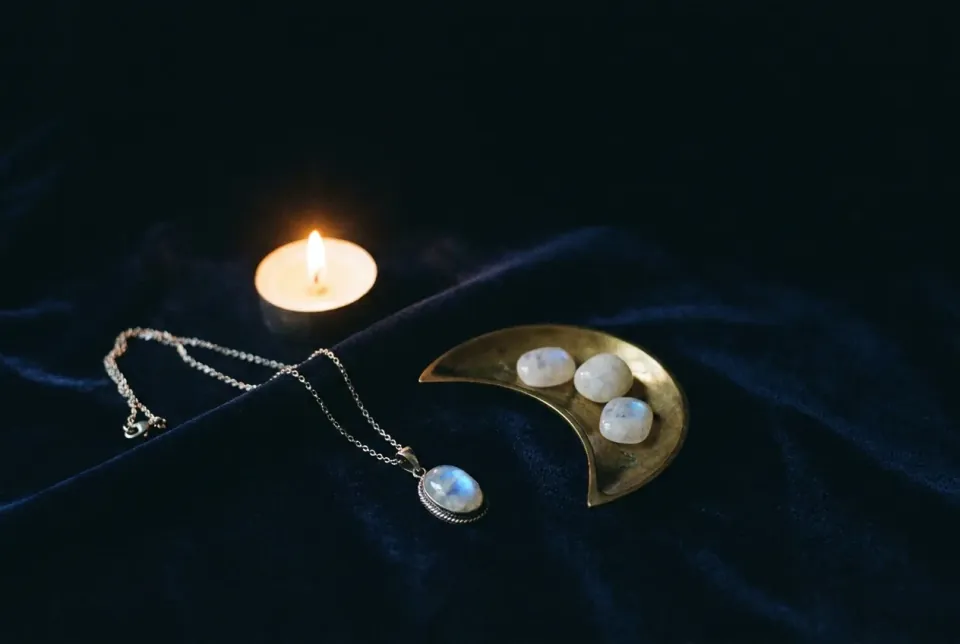
Turn a moonstone pendant and the light seems to move below its surface. This is adularescence, a real optical effect created inside the feldspar. It is also the clearest image for the spiritual meaning of a moonstone necklace: intuition that appears gradually, trust in cycles and openness to a beginning before every detail is known.
Worn over the heart, moonstone can hold an intention for emotional honesty, receptivity and softer self-trust. Near the throat, it can support the practice of giving quiet knowledge a voice.
The light comes from the stone’s structure
Moonstone belongs to the feldspar family. GIA explains that it is a variety of the feldspar-group mineral orthoclase. As the gem forms, orthoclase and albite separate into alternating microscopic layers. Light enters those layers and scatters, creating the glow that seems to billow through the stone.
That glow is called adularescence. A fine moonstone may look milky when held still, then show a blue or white flash when the pendant tips toward a window. The light is not a coating placed on top. It depends on internal structure, cut and viewing angle.
This physical behavior keeps moonstone’s symbolism from becoming abstract. You have to move the stone to see what it carries. Intuition can work in the same way. An answer that is invisible under hard overhead light may become clear during a walk, in the pause after a conversation or when your hand closes around the pendant at the sternum.
Gemstones have long entered personal meaning through touch and adornment. The V&A’s gemstone guide documents historical amulets in which color, pattern and contact with the skin were understood to carry protective force. That history does not prove one universal moonstone meaning. It shows how readily a physical stone can become part of prayer, protection and intimate ritual.
Heart, throat and the place between them
A necklace gives moonstone a different role from a ring. The pendant rests with the breath and rises when the chest rises. It can disappear under a shirt, then return to the hand when you need it. Its placement does not follow an ancient rule tied to a precise chain length. Choose the place that makes the practice easy to feel.
At the heart, moonstone is often chosen during a tender transition: the beginning of love, the end of a familiar role, a return to creativity or the slow work of receiving care without suspicion. Its lunar association makes room for changing emotional tides. The stone does not ask every day to feel the same.
At the throat, the intention turns toward expression. This placement suits the moment when you know something inwardly but have not said it yet. Touch the pendant before naming a need, asking a question or admitting that an old plan has changed.
A chain that lands between the two can hold the passage from feeling to speech. Let the pendant rise with one breath. On the exhale, say the simplest true sentence available.
What moonstone symbolizes in spiritual practice
Moonstone is commonly associated with the Moon’s energy, love and protection in gem lore. The International Gem Society’s moonstone guide records those associations while separating them from the stone’s mineral properties. Modern crystal practice has extended that lunar language into several related intentions. If you arrived here through an astrology chart, our guide to zodiac stones and why the lists disagree explains why moonstone can appear beside different signs without being the one official stone for any of them.
Intuition is the ability to notice a quiet signal before the mind builds a full argument around it. Moonstone can mark a commitment to listen without turning every feeling into a prophecy.
Cycles include the monthly rhythm many women recognize, but the meaning is wider than the body. Work expands and contracts. Grief changes shape. Creativity has fertile periods and fallow ones. Wearing moonstone can affirm cyclical living without making claims that the gem regulates hormones, fertility or health.
Emotional flow means allowing a feeling to move without handing it control of the whole day. The pendant offers a place to pause, name what is present and decide what belongs in action.
New beginnings suit moonstone because its light does not arrive all at once. Choose it when starting a home, practice, relationship, course of study or identity that still feels delicate. The stone can hold the first promise while the rest takes form.
Travel and protection have long belonged to moonstone lore. A traveler might wear it to stay receptive and alert, leave one place cleanly and arrive in another with her energy intact.
The feminine quality associated with moonstone is not a narrow instruction about who may wear it. It names receptivity, rhythm and inward knowing. Those currents are available to any wearer.
Moonstone and rainbow moonstone are related, not identical
Jewelry listings often use “moonstone” and “rainbow moonstone” as if the terms were interchangeable. Gemologically, they are different.
The International Gem Society explains that stones sold as rainbow moonstone are technically a transparent variety of labradorite, another feldspar. Their blue, green and sometimes orange color play is labradorescence. Traditional moonstone is associated with adularescence, usually a floating blue-to-white sheen. The gem trade commonly accepts the rainbow moonstone name, but a careful seller should still tell you what is being offered.
Spiritually, the distinction can guide the choice without making one superior. Classic moonstone often feels quiet, inward and pearl-like. Rainbow moonstone brings brighter flashes and can suit an intention that needs visibility or movement. Look for a listing that names the material, any treatments, the metal and the setting. Natural variation is expected, so request a photograph of the actual pendant when the exact flash matters.
The Moon Magic review looks more closely at a brand built around moonstone and modern gemstone settings. For a more colorful, symbolic jewelry language that also includes moonstone, see the Daya Jewelry review.
Who may feel called to a moonstone necklace
Moonstone often catches the attention of a person standing at a threshold. The outer change may be obvious, such as travel, a move or a new role. It may also be private: trusting a desire that has returned, ending a habit of overexplaining or letting a gentler pace replace constant urgency.
It can be a useful talisman when you want guidance without force. Black stones may feel too armored for the season. Bright solar stones may ask for more outward momentum than you have. Moonstone keeps the question open long enough for a subtler answer to arrive.
The practical test is simple. Does the pendant invite your hand? Can you see its flash in the light you actually live in? Does its chain place the stone where your body can find it without looking? Spiritual resonance and wearable construction need each other.
A new-moon threshold ritual
Use this ritual on the dark moon, the first evening of a new cycle or any night before a meaningful beginning. It takes about five minutes and does not require leaving the necklace outdoors.
Place the necklace in a shallow dish beside a doorway. On one small piece of paper, write what is complete. Keep it concrete: waiting for permission to begin, answering before I have listened, carrying a role that ended.
Stand on the old side of the doorway with the pendant in your palm. Take one breath and read the sentence once. Turn the paper face down. Put on the necklace, then let the stone settle at your heart or throat.
Cross the threshold. On the other side, speak one intention in the present tense: I listen before I choose, or I let this beginning unfold at its honest pace. Touch the pendant and take one step toward an action that belongs to the new cycle. Send the email draft, open the notebook or place the packed bag by the door.
The ritual is finished when intention enters movement. If the necklace also needs energetic clearing, choose a material-safe method from the guide to cleansing and charging spiritual jewelry.
Protect the stone from knocks
Moonstone needs gentler handling than its otherworldly light may suggest. GIA gives it a Mohs hardness of 6.0 to 6.5. Hardness describes resistance to scratching, while daily survival also depends on the stone’s tendency to cleave or chip. The International Gem Society advises protective settings and notes that pendants and brooches face less exposure than rings. A pendant is a sensible form for moonstone, but it can still strike a sink, table edge or another piece of jewelry.
Store the necklace flat in a padded compartment so the stone cannot knock against harder gems and the chain cannot pull across it. Remove it before exercise, sleep or any task likely to swing the pendant into a hard surface. Put perfume and body products on before the necklace.
IGS recommends warm soapy water and a soft brush for moonstone, and advises against ultrasonic and steam cleaners. The chain, plating, adhesive or companion stones may require an even drier method, so follow the care limits of the whole piece. When uncertain, use a soft cloth and ask the maker or a jeweler.
If the moonstone cracks or the necklace breaks
Stop wearing a visibly cracked stone until a jeweler checks whether it is secure. Examine the bezel or prongs, chain, clasp and jump rings too. A blow, worn fitting or snagged chain can explain the damage. Physical cause and spiritual feeling can exist in the same moment.
After the piece is safe, ask what changed around the break. A crack may feel like a cycle closing, a boundary reached or pressure that can no longer be carried in the old form. It may invite repair rather than release. There is no single moonstone omen, and damage is not evidence that you ignored your intuition.
Keep every fragment in a small dish or envelope. The guide to the spiritual meaning of jewelry breaking offers grounded ways to listen before deciding whether to repair, reset or retire a piece.
Moonstone’s lesson remains visible even then. Light meets a layered interior and changes direction. The necklace can remind you to do the same: turn slightly, look again and let the next step appear without forcing noon brightness onto a new-moon hour.