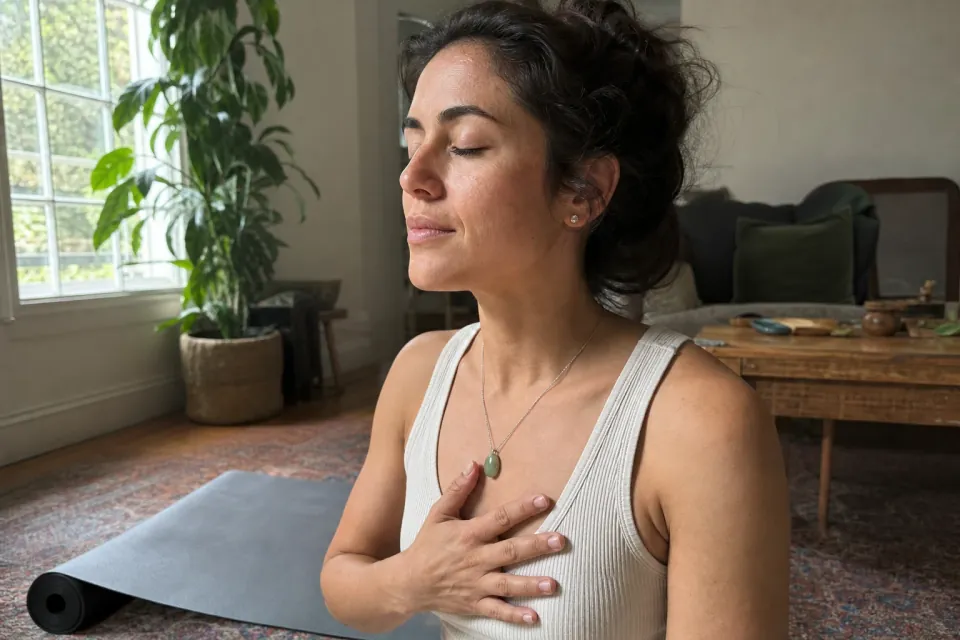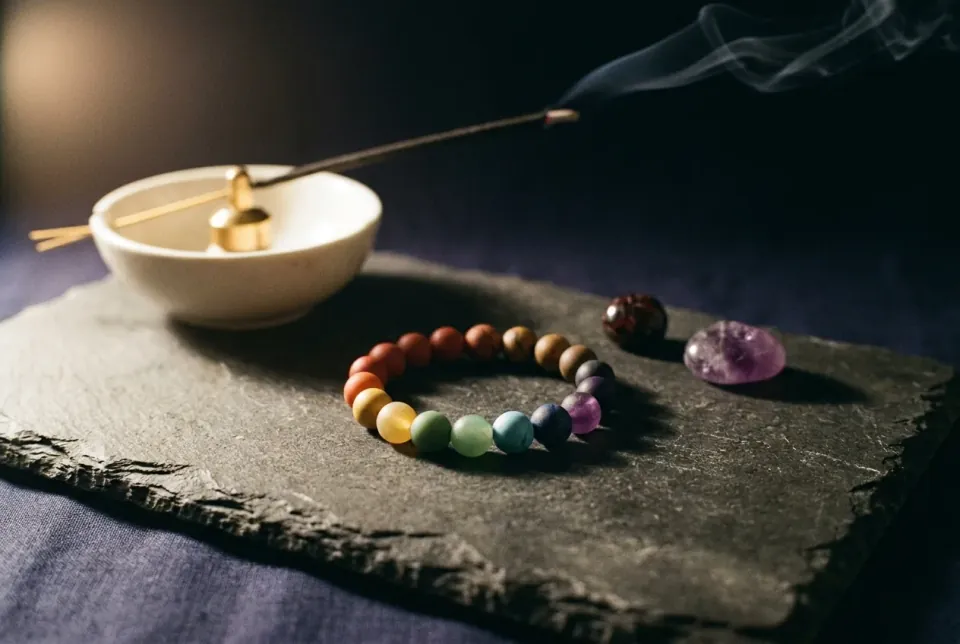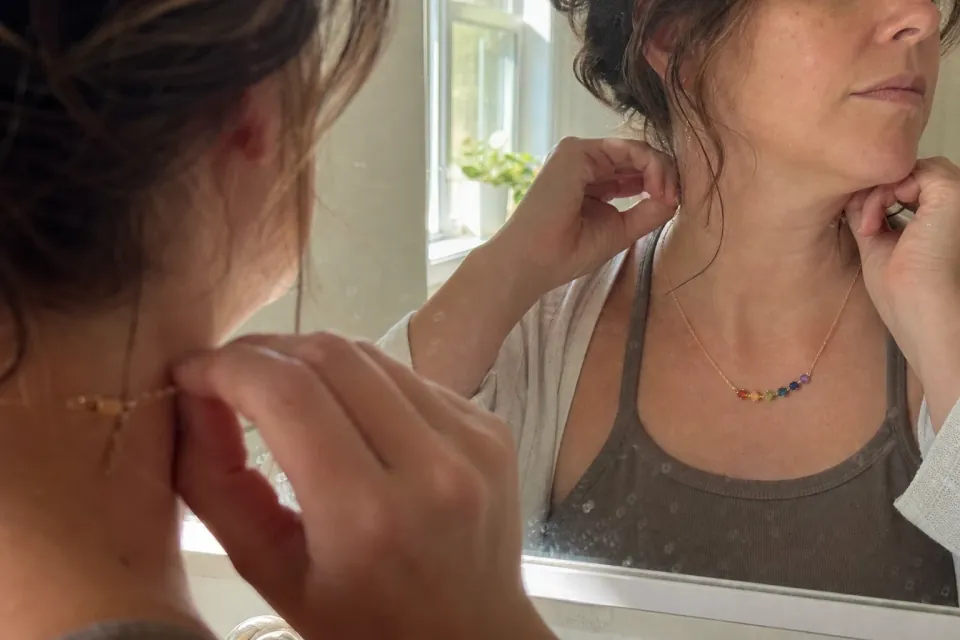
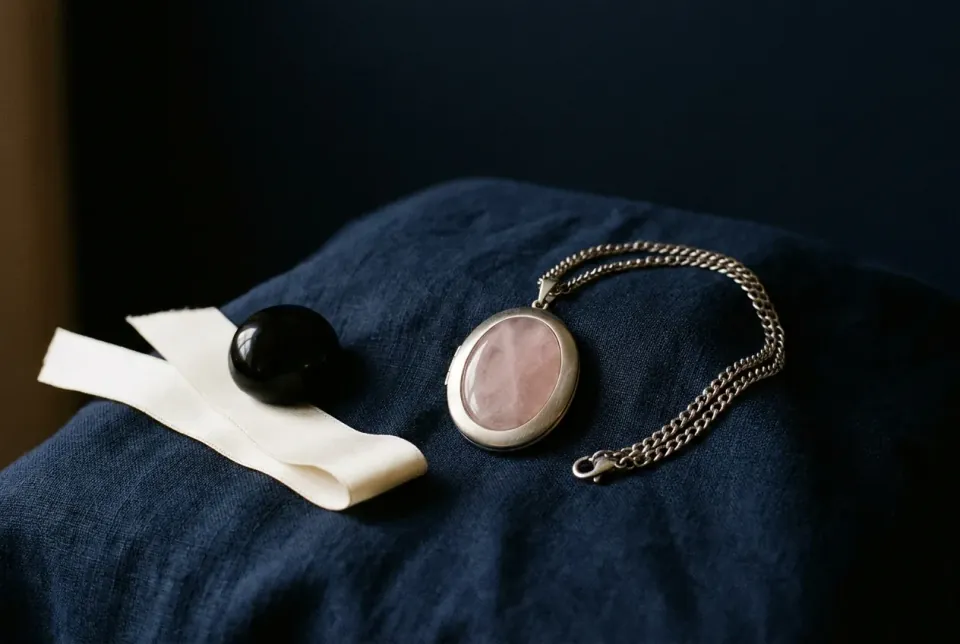
A small locket can become impossible to open. The hinge still works. The photograph inside has not changed. Yet on one morning the thumb stops at the clasp, because opening it would make the absence too present. On another morning, touching the closed case is the only bearable thing.
Grief changes the weight of objects. A ring becomes a voice. A pebble becomes the last walk. Jewelry can hold this pressure because it already lives close to the body. It can be touched without explanation and carried when a photograph feels too exposed.
Crystals enter this space as ritual objects, not cures. Rose quartz, obsidian and malachite each carry an association in contemporary spiritual practice. None has been shown to treat grief. This guide keeps the geology, the spiritual reading and the human need separate, then offers a practice that asks no stone to do a person’s work.
Grief needs more than a stone
Grief is not one mood with a predictable timetable. The NHS guidance on bereavement and loss names shock, numbness, sadness, exhaustion, anger and guilt among common experiences. It also notes that powerful feelings can arrive unexpectedly and affect people differently.
That range matters when choosing jewelry. A heavy pendant may feel grounding one week and unbearable the next. A bright green stone may offer life and movement, then feel too loud. There is no spiritually correct piece and no failure in taking one off.
Grief usually needs time, other people and permission to change shape. Sometimes it also needs professional help. Speak with a healthcare professional or counsellor if you are struggling to cope, if low mood persists or if your own efforts are not helping. Seek urgent local support if you may harm yourself. Crystals and ritual can accompany care; they do not replace it.
The scientific boundary is also clear. A 2025 randomized controlled study indexed by the U.S. National Library of Medicine compared rose quartz with a visually matched placebo during a fourteen-day anxiety protocol. Reported improvement did not differ by object. Belief predicted the response, not whether participants held rose quartz. The study concerned anxiety rather than bereavement, but it gives no basis for claiming that a crystal has an inherent clinical effect.
That does not make a chosen object meaningless. It changes the claim. A smooth stone can be a cue to breathe, call someone or eat. A necklace can carry a photograph or name. The action belongs to the person and the relationship, not to an invisible medical property in the mineral.
Rose quartz for tenderness, not erasure
Rose quartz is the gentlest visual choice here: cloudy pink, usually translucent rather than perfectly clear. The Gemological Institute of America’s history records rose quartz jewelry in ancient Mesopotamia and later talismanic uses of quartz across several cultures. It also notes the modern name “love stone” and the belief that rose quartz balances emotion and softens anger or disappointment.
Those facts do not establish one continuous grief tradition. The modern association works because love remains present after a death, separation or other loss. Rose quartz gives that love a material color without requiring the wearer to call grief beautiful.
Choose it when the practice is tenderness. A pendant near the heart can become a reminder to stop speaking to yourself as if sorrow were poor performance. A bead in a pocket may suit someone who does not want visible memorial jewelry. A ring can be useful when the hand needs a cue during paperwork, meals or the first return to work.
Quartz is relatively hard, but a stone can still chip and a setting can still fail. Check the bezel, prongs and chain. Pale rose quartz may also fade after prolonged strong light, so do not leave the piece in a sunny window as a charging method. Use sound, a dry cloth or a brief personal dedication instead. Our cleansing and charging guide separates spiritual ritual from material care.
Obsidian and the name “Apache tear”
Obsidian forms when silica-rich volcanic material cools into natural glass. The small rounded nodules sold as Apache tears are a geological form of obsidian. A U.S. Geological Survey field image identifies nonhydrated obsidian nodules, called Apache tears, inside a perlitic matrix.
Modern crystal practice often assigns black obsidian to truth, protection and the willingness to face what hurts. The rounded nodule makes a convincing grief object because it looks opaque in the hand but may glow brown at a thin edge when held to light. That is an optical property, not proof of a spiritual force. As a metaphor, it is enough.
The trade name carries a problem. Sellers often repeat a story in which Apache women wept stones after warriors died in conflict with the U.S. Cavalry. Most retail versions give no named Apache narrator, community publication or primary record. Do not present that moving story as verified tribal teaching. Do not use the word “Apache” as decoration while ignoring living Apache peoples.
If you choose this material, name it accurately and keep the claim narrow: a rounded obsidian nodule sold under the trade name Apache tear. Ask the seller where it was collected and whether collecting was lawful. Plain black obsidian is the cleaner choice when the unsupported legend feels intrusive.
Use obsidian when the practice is witness rather than comfort. Hold it for five minutes while naming one fact you have avoided: the person is gone, the relationship ended, the home was lost, or the future changed. Then put the stone down and do one caring physical action. Drink water. Open a window. Message the person who said you could call.
Malachite for change that cannot be rushed
Malachite is a copper carbonate mineral with bands of light and dark green. Encyclopaedia Britannica describes its use as an ornamental stone and gemstone, as well as its occurrence in the weathered zones of copper deposits. Those physical facts come before any spiritual interpretation.
Contemporary crystal practice often links malachite with transformation. That word can become cruel around grief if it implies that loss arrived to improve someone. A better use is modest: the green bands mark that life and pain can exist in the same object. Change happens, but nobody must be grateful for its cause.
Malachite needs careful handling. It is softer than quartz, and household chemicals can damage its polish. Buy a finished, securely set stone from a seller who states the material and any treatment. Do not make crystal water with malachite. Do not grind, drill or sand it at home, because copper-bearing dust does not belong in a ritual or in your lungs.
Choose malachite when a threshold needs recognition: the first birthday after a death, moving out after a separation, donating clothes or returning a key. Wear it for the act, then store it separately in a soft pouch. The piece can mark change without declaring the mourning complete.
Memorial jewelry holds what crystals cannot
Sometimes the most honest grief jewelry is not a healing stone. It is a locket, an engraved band, a watch, a religious medal or a plain chain that belonged to the person who died.
This use has a long material history. A 1706 American mourning locket at The Metropolitan Museum of Art holds woven human hair beneath crystal and bears a skull and death date on the reverse. The museum notes that early American jewelry often marked courtship, marriage, death and mourning. The object did not remove grief. It kept a specific person physically near.
A modern locket can hold a photograph, a copied handwriting sample or a tiny piece of fabric. An engraved ring can carry initials, coordinates or a date. If you reset an inherited stone, ask the jeweler to document the original piece before work begins and return unused metal or stones. Sentiment does not protect fragile settings.
Memorial diamonds need extra care as a purchase category. Companies may offer laboratory-grown diamonds represented as containing carbon from hair or cremated remains. Ask for written details about the process, how the submitted material is tracked, whether other carbon is added and what independent grading covers. A gem report can describe the finished diamond; it does not automatically verify the personal origin of its carbon. Never let urgency or guilt replace normal purchase checks.
For help with metal, fit, setting and seller questions, use our guide to choosing spiritual jewelry. If an inherited piece breaks, the guide to broken spiritual jewelry begins with physical causes before symbolic readings.
A practice for carrying, not curing
Choose one piece only. Let it be a crystal, a memorial jewel or an ordinary object that already holds the bond. Set aside ten quiet minutes and bring a small box or cloth.
- Name what the piece holds. Say one sentence without improving it: “This locket holds my love for Ana,” or “This stone reminds me to stay beside myself today.”
- Name what it cannot do. Say: “You cannot remove this loss or make decisions for me.” This protects the object from an impossible job.
- Choose one return action. Connect touching the piece to a real act. Take three breaths. Eat something. Step outside. Send one message. Write one memory.
- Set a rest place. Put the box somewhere accessible. If the jewelry becomes too heavy, remove it without apology. Resting the piece does not abandon the person or the meaning.
- Review after a month. Ask whether the object supports contact with life or keeps you inside distress. Change the ritual, the piece or the support around you.
Do not cleanse inherited jewelry as if the person attached to it were contamination. Clean the material safely if needed. Spiritually, you may simply welcome the piece into its new role. A sentence of gratitude is enough.
The weight can change
Return to the locket that would not open. One day it may open easily. Another day it may stay closed in a drawer. Neither moment proves that grief has ended or that love has weakened.
A stone is most trustworthy when it remains a stone. It has color, weight, fracture lines and limits. The wearer supplies memory and practice. The living supply food, company, skilled care and time. Together, those forms of support can make the next hour carryable, which is often the only promise grief will accept.