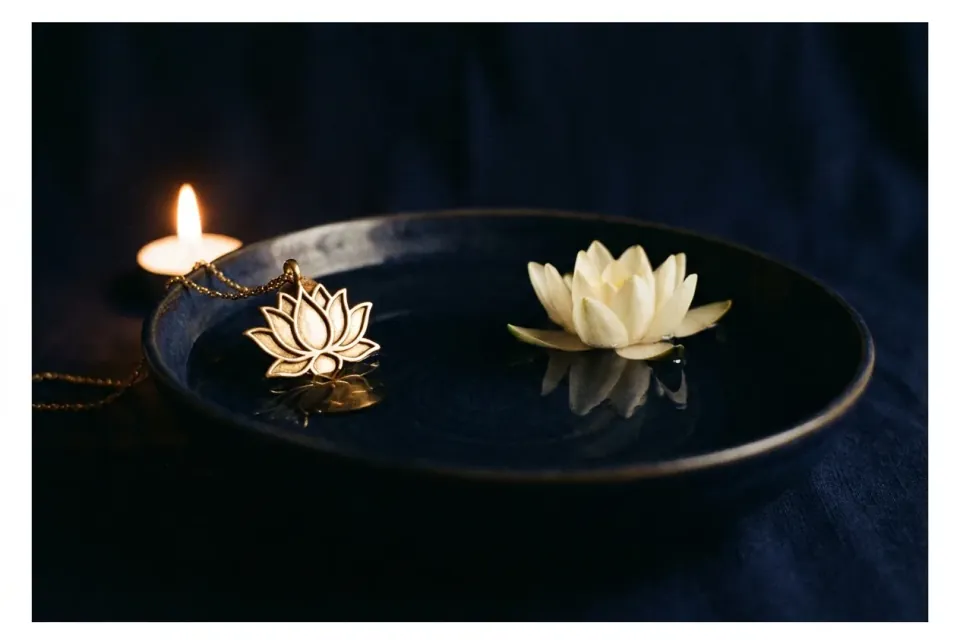
Below the water, the sacred lotus is anchored in mud. Its stalk rises through the pond. Leaves and flowers lift above the surface, and the bloom opens to light.
That physical life gives a lotus necklace its clearest meaning: awakening, purity, rebirth and resilience that does not deny difficult conditions. The pendant can mark a beginning shaped by what came before it. It carries the possibility of staying open after grief, recovery or a long season of discipline, without pretending the mud was beautiful while you were inside it.
Begin with the living plant
The sacred lotus, Nelumbo nucifera, is an aquatic plant found in tropical and subtropical Asia. Encyclopaedia Britannica’s botanical account describes large round leaves held above the water and flowers rising on strong, leafless stalks. The plant’s roots remain in muddy water while the bloom rises into air and light.
A lotus is related only distantly to water lilies, despite the visual resemblance. That detail matters because symbolic language often turns the flower into an abstract icon. The plant has weight, habitat and a way of growing. A pendant keeps only the outline, so its meaning deepens when you remember the whole pond beneath it.
The flower opens without erasing the mud. That makes the lotus feel honest during change. It makes room for pain and growth in the same image.
The lotus in Buddhist practice
In Buddhist contexts, the lotus is closely associated with enlightenment. A Tricycle essay on engaged Buddhism builds its teaching from the flower’s physical movement: rooted in mud, rising through murky water and seeking light. The writer connects the lotus with mindfulness, responsible response and the bodhisattva commitment to help others.
This gives the symbol an ethical direction. Awakening is expressed through attention and conduct, not escape from the pond. The lotus can remind a wearer to see conditions clearly, pause before reacting and choose a response that reduces harm.
A lotus necklace used in a Buddhist practice should hold that context. It may accompany meditation, a vow of compassion or a commitment to return to awareness during ordinary conflict. The pendant is a cue for practice, not a shortcut to enlightenment.
The lotus in Hindu traditions
Britannica describes the lotus as sacred in Hinduism and connects the raised flower with the rise and spread of spiritual enlightenment. The plant is also sacred in Buddhism. That shared reverence does not make the two traditions interchangeable.
Hindu lotus imagery belongs within Hindu cosmology, devotional life and representations of the divine. Buddhist lotus symbolism develops through Buddhist teachings and practices. A modern necklace may draw visually from either context, or may use a simplified flower with no explicit religious motif. Read the full design before assigning it a meaning.
An Om placed inside a lotus, for example, carries a Hindu sacred syllable and deserves more care than a generic floral pendant. A Buddha figure seated on a lotus creates a specifically Buddhist image. The flower may appear in both traditions, while the composition tells you which context is present.
Ancient Egypt adds another distinct thread. Britannica notes that the lotus was used there to represent rebirth. That association should remain identified as Egyptian rather than folded into a single category of “Eastern spirituality.”
What a lotus pendant can hold in a personal life
A personal talisman does not need to imitate formal religious use. It should keep cultural history intact while allowing the symbol to meet the life being lived now.
The lotus often appears at thresholds. After grief, it can honor the slow return of appetite, color and interest without turning loss into a lesson. In recovery or sobriety, it can mark the daily work of choosing life within conditions that still require care. A new mother may read the open bloom as a self continually changing shape around love, fatigue and responsibility. A woman beginning a spiritual discipline may wear the flower as a promise to keep returning rather than a claim that she has arrived.
Other chapters fit too: leaving a controlling relationship, moving home, completing treatment, beginning again after burnout, returning to art or learning to live in a body changed by time. The lotus does not have to explain the whole story to other people. A small pendant can keep the meaning close and private.
If you are choosing among several symbols, the field guide to spiritual necklaces and their meanings can help separate a cultural symbol, a gemstone and a personal talisman.
Lotus colors in jewelry
Sacred lotus flowers occur in cultivated colors ranging from white to red, according to Britannica. Jewelry adds blue enamel, blackened silver, gold surfaces and multicolored stones. The listed sources do not establish one ancient color code shared across Buddhist and Hindu traditions.
Modern necklaces often use color this way:
- White suggests clarity, simplicity or a clean beginning.
- Pink lends the flower tenderness, affection or soft renewal.
- Blue is often chosen for insight, contemplation or disciplined calm.
- Gold can suggest illumination, devotion or the warmth of life returning.
Treat these as contemporary design readings. A white lotus in a specific Buddhist artwork may carry a meaning grounded in that tradition, while a white enamel pendant sold for “fresh starts” belongs to modern jewelry language. Context decides how much weight the color can bear.
Metal alone can create the mood. Polished silver gives an openwork lotus a quiet, reflective quality. Yellow gold makes the petals visible against the skin. Oxidized lines emphasize the spaces between petals and suit a design centered on endurance rather than delicacy.
Choose the stage of the flower
The shape of a lotus pendant often carries its clearest personal meaning.
An open bloom suits awakening, visibility and a chapter that is ready to be named. Its petals spread across the chest, and a larger design may catch on loose knits or fine lace. Check the edges before choosing it for daily wear.
A bud holds potential. It fits private beginnings, early recovery and intentions that need time before public attention. A small bud can sit near the throat like a promise still gathering form.
A geometric lotus reduces the flower to repeated lines and balanced petals. It can connect botanical symbolism with meditation, pattern and centered attention. Read the sacred geometry jewelry guide before treating every symmetrical lotus as a mandala. Geometry and sacred diagrams have their own histories.
A lotus combined with chakras may represent energy opening through the body. A lotus with Om enters a specific sacred context. A pendant with a deity, Buddha image or sacred text asks for closer study than a plain flower. Learn what is depicted and notice how the piece will be worn, stored and handled.
Scale matters. A tiny lotus at the collarbone feels like a private cue. A broad openwork bloom over the sternum becomes a visible statement. A long chain lets the flower move with the solar plexus and can support a practice focused on courage or renewed direction. These placements are contemporary ritual choices, not universal ancient rules.
A ritual for beginning again
Choose a morning when you can give the necklace five quiet minutes. Place it beside a bowl of clean water. The jewelry stays dry; the bowl represents the pond and protects delicate metal, stones or thread from unnecessary contact.
Write the chapter you are closing on a small piece of paper. Use plain words. Fold the paper once and place it beneath the bowl.
Hold the necklace above the water. Name one action that belongs to the new chapter. It may be attending the meeting, asking for help, making the appointment, taking the walk or keeping the boundary. Let the action stay small enough to complete.
Say:
I remember the ground that held me. I rise without denying it. May this beginning open through attention, courage and care.
Put on the necklace. Pour the water onto a houseplant or garden soil if it is plain and safe to do so. Keep the paper until you complete the action, then recycle it or tear it into small pieces.
This ritual can support manifestation when the desire is joined to conduct. The guide to using jewelry for manifestation offers a longer practice for giving one piece a focused intention.
Admiration needs context
A lotus can be admired across cultures, and its beauty is one reason the image travels so easily. Care begins when admiration asks questions. Which lotus is depicted? Is another sacred symbol placed inside it? Does the seller identify a Buddhist, Hindu or Egyptian context, or does the description merge them into vague spiritual language?
Yoga-linked symbols are often separated from the cultures and faiths that give them meaning. Jewelry raises the same question. A symbol can become personal without becoming ownerless.
Choose makers who name sacred motifs accurately. Avoid designs that place revered figures or syllables where they will be treated carelessly. If the necklace carries a tradition you do not belong to, let study remain part of wearing it. You do not need to claim the whole symbol to be changed by its image.
When the pendant shifts against your chest, remember the flower as a living thing. Mud below. Water around it. Air at the petals. The beginning is already connected to every condition that made opening possible.