Sometimes a pendant catches your eye before you know its name. You see the same open hand, crescent or coiled serpent in shop windows and saved photographs, and the recognition arrives before the explanation.
A spiritual necklace is a necklace worn in relationship with meaning. It may hold protection, devotion, remembrance, energy work, status, identity or a personal intention. The meaning can come from a living religious tradition, a gemstone, a symbol, or the life you build with the piece. Jewelry has carried rank, faith and protective purpose across many periods, as the V&A’s history of jewellery shows, but no single interpretation covers every necklace.
Symbol, stone or talisman?
These words overlap, but they are not interchangeable.
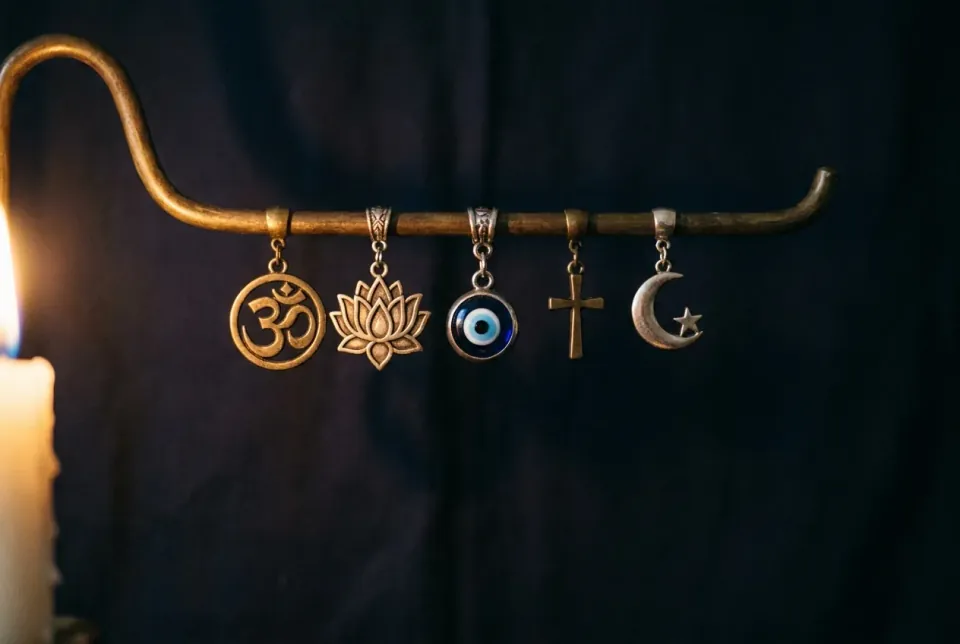
A symbol necklace carries an image with a recognizable language: a lotus, moon, hamsa, cross or tree. Its meaning may be religious, cultural or contemporary. Learning where the image comes from matters because a symbol can hold obligations and stories beyond its appearance.
A stone necklace begins with the material. Moonstone, amethyst or black tourmaline brings its own energetic character, while the setting gives that energy a place on the body. Gemstones also have physical identities and limitations. The V&A’s gemstone guide is a useful reminder that mineral facts, historic beliefs and modern spiritual readings are separate layers.
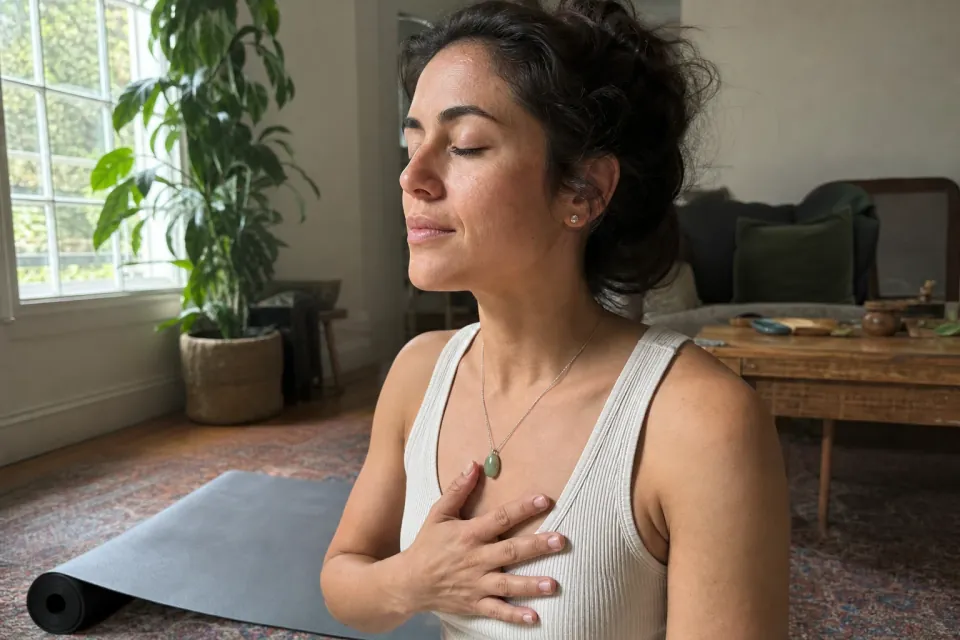
A personal talisman is defined by relationship. It may be a recognized protective amulet, a plain pendant dedicated during prayer, or a locket holding a photograph. Repetition deepens it. The hand finds it before a hard conversation; the chain is fastened on the morning of each new beginning. Meaning gathers around use.
A field guide to spiritual necklace meanings
Chakra stones: alignment across the whole field
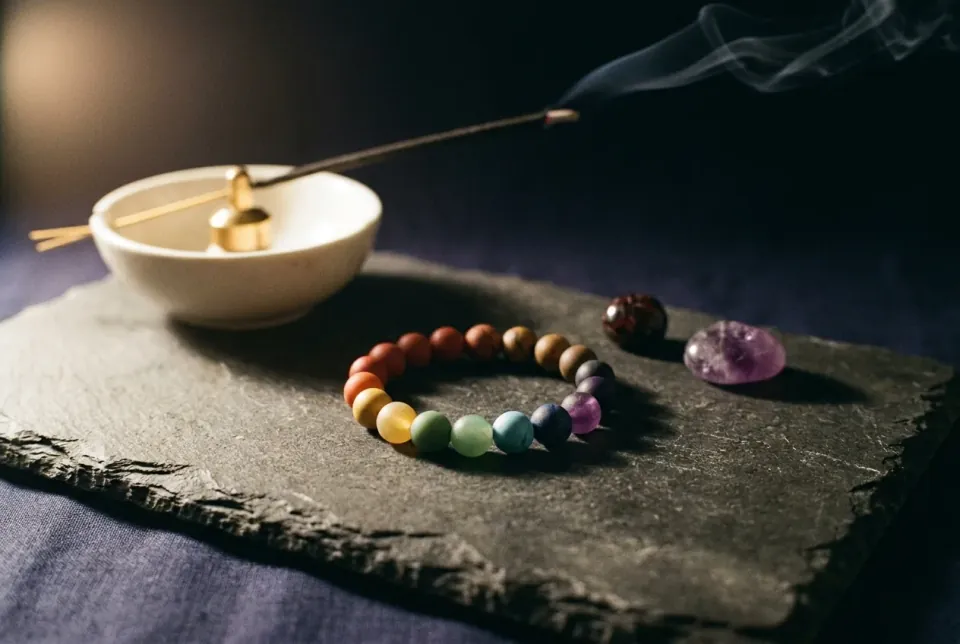
A chakra necklace maps the body’s subtle energy centers through color and stone. Yoga Journal’s chakra overview describes seven main centers from root to crown. Makers choose different gems for those colors, so there is no single required stone set.
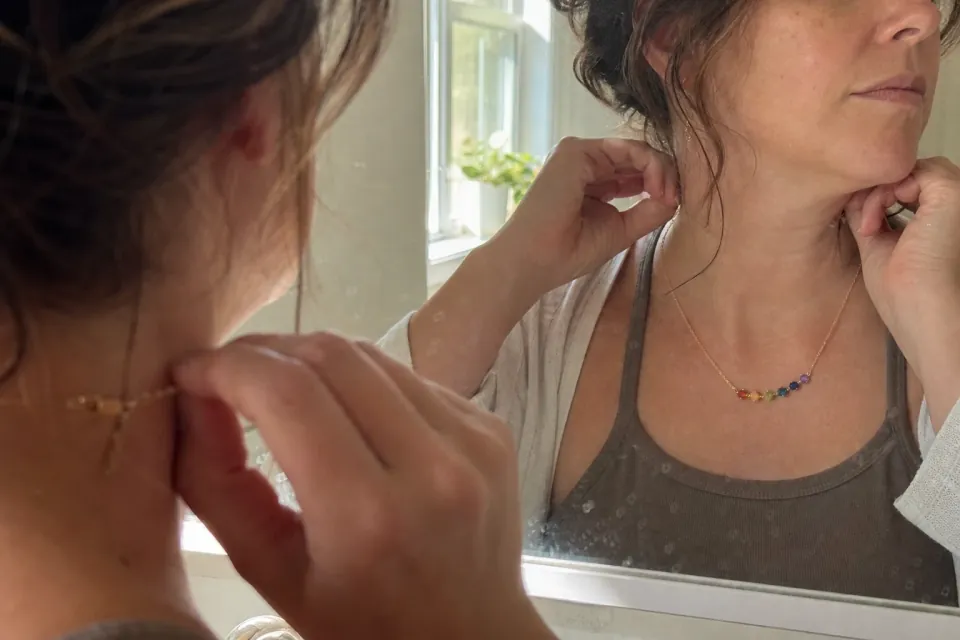
A seven-stone necklace is often chosen for alignment rather than one isolated intention. A single blue stone can focus a throat practice; green or pink can rest over the heart. If you want a ritual that moves through all seven centers, use the chakra necklace practice. A bracelet gives the same system a more tactile rhythm, explored in our chakra bracelet meaning guide.
Moonstone: intuition and life at the threshold
Moonstone appears to hold moving light below its surface. That effect, called adularescence, comes from light scattering between microscopic feldspar layers, according to the Gemological Institute of America. Its physical character makes a natural bridge to spiritual meanings of intuition, cycles and beginnings: the answer shifts as you turn it, yet the stone remains itself.
A moonstone pendant can accompany a new moon practice, travel or a season whose shape is still emerging. Our moonstone necklace guide looks more closely at the stone, care and ritual.
Evil eye or nazar: attention turned outward
The evil eye is the harmful gaze; the eye-shaped amulet is worn to deflect it. A blue nazar at the chest gives protection a visible face, particularly when the day involves scrutiny, envy or crowded energy. It can remind you to notice attention without absorbing it.
The amulet and the hamsa are distinct, even though an eye sometimes appears within a hamsa. Read the evil eye necklace meaning guide before choosing or gifting one.
Hamsa: an open hand with a boundary
The hamsa is an open-hand amulet with Jewish and Muslim histories. It is also known in different contexts as the Hand of Miriam and Hand of Fatima. Its origins are debated, and the Arabic word khamsa means five, as My Jewish Learning’s hamsa history explains.
Spiritually, the hand can hold blessing and protection at once. Some versions contain an eye, fish, prayer or other motif, each adding another layer. The hamsa necklace guide separates documented context from modern readings of hand direction.
Lotus: opening after difficult ground
A lotus pendant carries awakening, resilience and renewal. The flower’s roots and stem rise through mud and water before the bloom opens above the surface. That physical form gives the symbol its force: clarity does not require a spotless beginning.
Lotus meaning differs across Buddhist, Hindu and contemporary spiritual settings. Learn the context of the version you wear, especially when it is paired with a deity, mantra or om. The lotus necklace guide offers a tradition-aware path into the symbol.
Serpent: shedding and embodied change
A serpent curves around a chain rather than holding still like a medallion. It is commonly chosen for transformation, life force, sensual wisdom and the release of an outgrown identity. Yet serpent imagery varies widely across cultures and religions. Treat the exact design as a clue, not proof of one universal message.
A serpent can be right for the woman who is changing in ways others cannot yet see. Its question is practical: what has become too tight to keep wearing?
Tree of life: roots, kinship and continuity
The tree of life appears in multiple religious, mythic and contemporary traditions, with meanings that should not be collapsed into one origin story. In personal jewelry it often speaks to ancestry, family, growth and the bond between what roots below and what reaches upward.
Look closely at the design. A family tree pendant, a Kabbalistic tree and a decorative branching tree do not carry identical histories. Ask the maker to name the symbol rather than relying on a generic product title.
Sun and moon: radiance, rhythm and relationship
A sun pendant brings attention to visibility, warmth, courage and directed action. A moon holds cycles, intuition and changing forms. Worn together, they can mark a relationship between outward expression and inward listening.
The phase matters only if it matters to your practice. A crescent can hold emergence; a full circle can mark fruition or release. These are useful ritual readings, not fixed laws governing every lunar necklace.
Mandala and geometric forms: a center you can return to
A mandala organizes attention around a center. On a necklace, the pattern can steady the gaze during breath or meditation. Other geometric pendants, including circles, triangles and interlocking forms, carry their own histories and spiritual uses. Our guide to sacred geometry jewelry helps distinguish them.
Do not assume every circular floral pattern is a mandala. If a design comes from a named tradition, use its real name and learn how it functions there.
Om and faith symbols: devotion before styling
Om is a sacred syllable within Hindu traditions and is also used in some Buddhist and Jain contexts. A cross, Star of David, saint medal or other religious pendant likewise carries a living devotional meaning. These pieces may express belonging, prayer, remembrance or protection, depending on the wearer and tradition.
Approach them as religious symbols first. The respectful question is not simply, “Do I like the shape?” It is, “Do I understand what I am placing on my body, and can I wear it without stripping away its people, practice or name?”
Mala: a practice object that may be worn
A mala can hang like a necklace, but its first job is usually counting repetitions in japa. Bead spacing, cord strength and the distinct guru or meru bead serve the hand before they serve an outfit. Our source-led feature on Yogananda’s lineage and mala practice explains the 108-bead round, why the terminal bead is not crossed and how to begin without confusing japa with Kriya initiation.
Let placement support the practice
Chain length has no single ancient code. Placement becomes useful when it helps you remember why the necklace is there.
At the throat, a small pendant can accompany expression. Touch it before giving the answer you have been rehearsing. Over the heart, a stone or locket can hold love, grief, devotion or courage. A longer pendant near the solar plexus may support will, boundaries and visible action.
Comfort decides whether any of this can become real. Check the pendant drop against your usual necklines. Notice whether the edge turns, the chain catches hair or the stone feels too heavy by afternoon. The fuller guide to choosing spiritual jewelry covers metal, fit and daily wear without asking you to ignore intuition.
Start here: choose the practice already alive
You do not need to collect every protective or meaningful symbol. Begin with the part of your spiritual life that already has roots.
- For protection, consider a nazar, hamsa, faith symbol or dark grounding stone. Then read about protection jewelry for women.
- For love, choose a heart-centered stone, locket or symbol tied to a relationship you want to honor.
- For grounding, look for smoky quartz, black tourmaline, a tree or a piece with enough weight to feel when you touch it.
- For intuition, moonstone, amethyst, a crescent or an indigo chakra stone keeps the practice close.
- For expression, place a blue stone or personally resonant symbol near the throat.
- For transformation, a serpent, lotus, moon phase or labradorite can mark change without pretending the change is finished.
Once the intention is clear, compare construction and style through our spiritual jewelry brand guide. A necklace still needs a reliable clasp, a wearable chain and an honest materials description.
If a piece later cracks, falls off or breaks, gather it before deciding what the event means. The guide to jewelry breaking begins with the physical object, then makes room for energetic listening.
The right necklace does not need to announce every meaning it holds. It may sit under a shirt, known only by the slight weight at your sternum and the movement of your hand toward it. That private return is where a symbol stops being an idea and begins to live with you.