Rain had begun on the morning Mukunda Lal Ghosh tried to leave home for the Himalayas. He heard the wheels of his friend Amar’s carriage, tied a blanket around a pair of sandals, a copy of the Bhagavad Gita, a picture of Lahiri Mahasaya, two loincloths and a string of prayer beads, then dropped the bundle from a third-story window.
The future Paramahansa Yogananda did not make it far. His brother had anticipated the escape. Yet the inventory in Autobiography of a Yogi remains telling. The prayer beads were not an accessory added after the spiritual life had become public. They belonged among the bare things a teenage seeker thought he would need.
That small scene offers a better way into the mala than a catalogue of stones. A mala is a counting tool, a devotional object and, sometimes, something worn. Its meaning does not come from appearing holy. It comes from repetition.
What the bundle tells us
The Sanskrit word mala can mean a garland, wreath or string, as the Monier-Williams Sanskrit Dictionary records. In devotional practice, the word commonly names a strand used to count repetitions of a mantra or divine name. That repetition is japa.
The distinction matters. A mantra is not merely an attractive phrase, and a mala is not merely a necklace with many beads. In Swami Sivananda’s teaching for the Divine Life Society, japa begins with repeated attention to a mantra or name of God. The Bhagavad Gita gives the practice scriptural weight: in 10.25, Krishna identifies himself with japa among forms of sacrifice.
That is the documented lane. Contemporary wearers may also use beads for grounding, intention or a daily pause. Those are valid modern practices when named as such. They should not be passed off as one unchanged rule followed by every Hindu lineage.
Yogananda’s lineage is larger than one object
The official Self-Realization Fellowship lineage names Mahavatar Babaji, Lahiri Mahasaya, Swami Sri Yukteswar and Paramahansa Yogananda. In the account preserved by the organization, Lahiri Mahasaya taught Kriya Yoga to householders, Sri Yukteswar trained Yogananda and Yogananda carried that line of teaching to the West.
A mala should not be confused with Kriya Yoga. Kriya is the lineage’s initiated meditation discipline; japa is repetition of a mantra or divine name. A practitioner may value both, but the beads do not represent the whole method, and buying them does not confer initiation.
What links the object to the lineage is a sterner principle: practice outranks display. In Autobiography of a Yogi, Yogananda recounts Lahiri Mahasaya’s instruction that Kriya’s power lies in practice, not in filing away an inspiring theory. Elsewhere in the book, Yogananda translates a song by the poet-saint Mirabai that refuses to treat counting as a spiritual shortcut: “If the counting of rosaries uncovered Him / I would say my prayers on mammoth beads.”
The beads matter. Love and attention matter more.
Why 108 beads, and what is the guru bead?
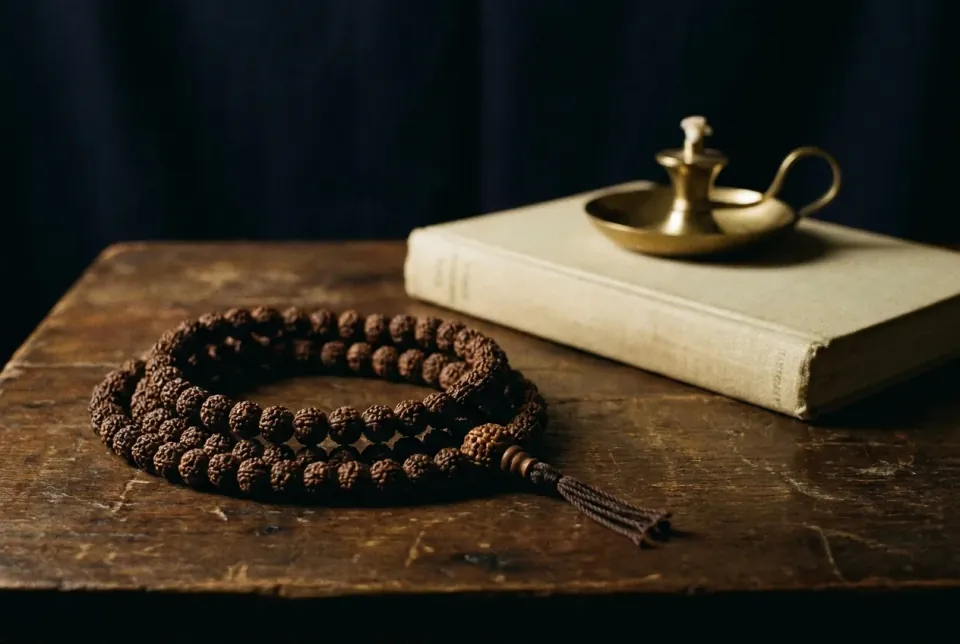
A full japa mala commonly carries 108 counting beads plus one distinct terminal bead. Swami Sivananda instructs practitioners to repeat a mantra in rounds of 108 and to use a 108-bead rudraksha or tulsi mala. He calls the terminal point the meru and tells the practitioner not to cross it, but to reverse direction when a round is complete.
That terminal bead is also widely called the guru bead. It marks the place where one round ends. It is not simply bead number 109. Reaching it creates a pause: remember the teacher, remember the purpose, turn the strand and begin again without climbing over the marker.
There is no single explanation that accounts for every use of 108 across every Indian tradition. Yogananda notes in an early footnote to his autobiography that Hindu scriptures give 108 names for God, each with a different shade of meaning. Other lineages connect the number with their own cosmologies, texts or ritual counts. The honest answer is plural. What stays practical is the round itself: 108 touches give devotion a beginning, a duration and a clear return.
Shorter wrist malas and counter strands may use factors of 108, often 27 or 54 beads. Those can be useful, especially when a full strand is awkward to carry. They are adaptations of the counting form, not proof that every bracelet sold as a mala follows a particular lineage.
A mala is not quite a necklace
A necklace is designed first to be worn. It may still carry deep spiritual meaning, as our field guide to spiritual necklaces explores. A japa mala is designed first to be handled in sequence.
That changes its construction. The beads need enough space to move one at a time. The cord must survive repeated friction. The meru or guru bead must be easy to recognize by touch. Decorative spacers, charms and pendants should not make the count ambiguous. A strand can be beautiful, but beauty serves the hand.
It also changes the etiquette. Customs differ by lineage. Sivananda’s instructions keep the mala near the heart, cover it during practice, roll the beads with the thumb and middle finger and turn at the meru. Other teachers may give other instructions. If a guru or community gave you a mantra and a method, that guidance takes precedence over a general article.
Wearing a mala around the neck or wrist can keep the practice close, but it can also turn a private counting tool into public jewelry. Neither choice is automatically disrespectful. Ask what the strand was made for, whether your tradition treats it as private, and whether the materials tolerate skin oils, water and daily abrasion. The practical checks in our guide to choosing spiritual jewelry still apply: identify the beads, inspect the cord and notice whether the piece can live with your actual day.
How counting gives the mind less to do
A restless mind loves two jobs at once. Give it a mantra and it starts keeping score, planning dinner, replaying a conversation and wondering whether the practice is working.
The bead removes one job. There is no arithmetic to hold. Thumb meets bead, the phrase is repeated, the bead moves, and attention begins again. When the mind wanders, the next bead does not accuse it. The bead simply offers a place to return.
This is a spiritual and practical claim, not a claim that the material itself produces a medically measurable effect. Rudraksha, tulsi, sandalwood, crystal and seed malas carry different devotional and contemporary associations. Their first shared function is tactile sequence.
Over time, the strand can gather memory. The first bead may feel noisy. The twentieth may arrive with a slower breath. By the final quarter, the hand often knows the rhythm without supervision. The count has not freed the mind by forcing it blank. It has given attention a narrow path through the noise.
A simple round of japa
This practice is for a person beginning with an open devotional mantra or divine name, not for reproducing an initiated mantra learned in confidence from a teacher.
- Choose one phrase. Use a divine name, a short prayer from your own tradition or a simple open mantra you understand. Do not collect five for one sitting.
- Sit for one round. Place both feet on the floor or take a steady seated posture. Let the spine rise without becoming rigid. Put the phone out of reach.
- Hold the first counting bead. Begin beside the guru bead, not on it. Let the strand rest rather than pull tight.
- Repeat once per bead. Speak softly enough to hear yourself, whisper or repeat inwardly. Move one bead after each full repetition.
- Return without drama. When thought carries you away, notice it and come back at the bead already in your fingers. There is no need to restart the round.
- Turn at the guru bead. After the final counting bead, pause. Do not cross the terminal bead. If you want another round, reverse direction.
- Sit for one quiet minute. Put the mala down or hold it still. Let repetition give way to listening.
A full round may be too much on the first day. Begin with 27 repetitions for a week, using a shorter counter or moving through one quarter of a full mala. Consistency is more faithful than an ambitious practice abandoned by Thursday.
The object returns to the hand
The young Yogananda packed prayer beads for a dramatic journey and was sent home before the journey properly began. Years later, the book first published in 1946 would carry his teachers far beyond the room where he wrote it.
The mala teaches on a smaller scale. You do not reach the distant mountain all at once. You take the next bead. The hand moves, the name returns, and what looked like jewelry becomes practice again.