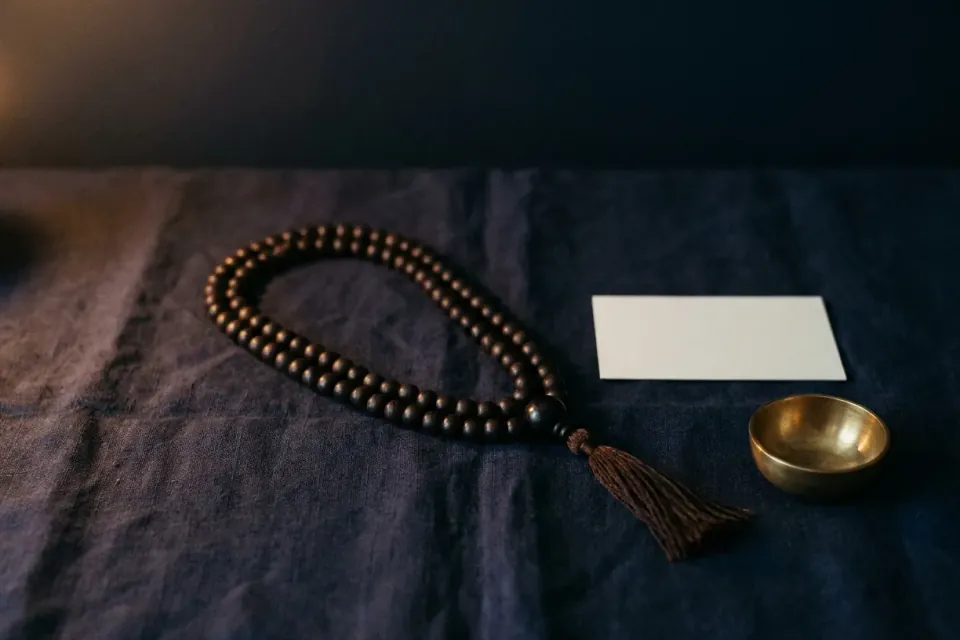
The first problem appears around bead thirty-seven. The sentence that felt clean at the beginning starts to sound awkward. The mind proposes a better word, then a different intention, then tea. The thumb waits on one dark wooden bead while the whole project tries to escape through revision.
This is the useful moment. Repetition has moved past novelty. What remains is the meeting between a phrase and the habits that resist it.
A mala can hold that meeting, but the terms need care. Repeating a personal affirmation 108 times is not traditional japa. Japa belongs to Hindu devotional and meditative practice, where a mantra or divine name is repeated aloud, softly or inwardly. A modern manifestation phrase has a different source and purpose. This ritual borrows the count, tactile rhythm and disciplined container while keeping the difference visible.
What belongs to japa
The Sanskrit word japa refers to repeated recitation. In the Bhagavad Gita, Krishna identifies himself with japa among sacrifices in chapter 10, verse 25. The practice has many forms across Hindu traditions, but devotion, mantra and repetition are central rather than optional decoration.
A mantra is also more specific than a motivational sentence. Encyclopedia.com’s reference entry describes mantras as sacred utterances used in religious practice. Some mantras name or address a deity. Others include syllables whose force is understood through a particular religious tradition. They may be spoken, murmured or repeated inwardly.
The mala gives the hand a way to count without asking the mind to keep a running total. A full japa mala commonly has 108 counting beads and a distinct terminal bead. The reference entry for mala across Hindu, Buddhist and Sikh practice describes strands of 108 beads used to count repeated recitations.
Swami Sivananda’s instructions for the Divine Life Society call this terminal point the meru. The practitioner starts beside it, moves one bead for each repetition and turns the strand at the end instead of crossing over the meru. Customs vary, and guidance received from a teacher or lineage takes precedence over a general magazine ritual.
Our earlier history of mala practice in Yogananda’s lineage follows these distinctions in more detail. The crucial point here is simple: japa is not a productivity technique wearing sacred jewelry. It is a religious practice with living communities, teachers and devotional purposes.
What this ritual changes
This article uses the architecture of one round for a contemporary affirmation. The phrase does not claim to be a mantra. The goal is not initiation, divine invocation or mastery of a lineage practice. It is sustained attention to one chosen direction, followed by an action that supports it.
That is why I call the ritual borrowed rather than traditional. The word is not an apology attached at the end. It is an instruction. Do not rename an affirmation as a Sanskrit mantra to make it sound older. Do not claim that 108 repetitions force the universe to produce an outcome. Do not sell the mala as a machine that turns desire into certainty.
Use the count for what it can honestly provide: duration, friction and return. One repetition can express a preference. One hundred and eight repetitions reveal where the phrase feels false, inflated or detached from conduct.
This is also a quieter answer to the promise of speed in manifestation culture. Our earlier guide to using jewelry as a manifestation cue treats the piece as a reminder that connects intention with choices. The reminder does not control another person, cancel material conditions or replace work. Repetition should narrow the gap between the sentence and the next honest act.
Why 108, without inventing one perfect answer
Hindu, Buddhist and Jain traditions all use 108 in more than one setting. Explanations differ by community and text. Some accounts connect the number with lists of names, passions, sacred sites or cosmological relationships. These meanings should not be flattened into one universal code.
The strongest claim for this practice is the plain one. Hindu mantras are often repeated 108 times, and a full mala commonly provides 108 counting beads. The number therefore gives one complete, recognizable round.
That round is long enough to change the texture of attention. At the beginning, the sentence leads. In the middle, boredom and objection appear. Near the end, the words may become quieter and the hand may carry more of the rhythm. None of this proves a supernatural mechanism. It shows what structured repetition does experientially: it makes leaving more noticeable and returning more concrete.
A shorter strand can still work. Twenty-seven beads completed four times make 108. Fifty-four beads completed twice do the same. If arithmetic distracts you, place four small counters beside the mala and move one after each round of 27. A notebook with 108 marks is also valid for this modern adaptation. The beads are a tool, not an admission ticket.
Choose a sentence that can meet reality
Write one sentence. Keep it short enough to say on one breath and honest enough that the body does not have to argue with every word.
Avoid promises about a specific person’s feelings or behavior. “Alex leaves their partner and chooses me” turns another person into an object of the ritual. Choose a statement about your own values and availability instead: “I make room for mutual, peaceful love.”
Avoid a sentence that denies present facts. If money is tight, “I am infinitely wealthy now” may create 108 small collisions with the bank balance. Try: “I meet money clearly and take the next sound step.” The phrase can point forward without pretending the journey is complete.
Connect the sentence to conduct. “My work reaches the people it can serve” can lead to publishing, asking for feedback or sending a proposal. “I build a home that feels safe” can lead to a savings transfer, a repair call or one cleared shelf. A manifestation practice becomes evasive when it replaces the action it could support.
Test the phrase three times aloud. Remove ornamental words. If it requires a paragraph of explanation, shorten it. Write the final sentence on a blank card and date it.
One round of 108 repetitions
Set aside twenty to thirty minutes for the first round. Later rounds may move faster, but speed is not the aim. Use a full mala, a shorter counter strand or a marked page.
- Place the sentence in view. Put the card beside the mala. Keep the space simple. One piece of jewelry and one card are enough.
- Name the borrowing. Say: “This is a modern affirmation practice using the 108-count form associated with japa. It is not traditional japa.” This prevents the source from disappearing once the ritual becomes personal.
- Choose the action. Write one action that can follow today’s round. Make it possible within twenty-four hours.
- Begin beside the terminal bead. Hold the first counting bead, not the guru or meru bead. Let the strand rest loosely rather than pulling it tight.
- Repeat once per bead. Say the complete sentence, then move one bead. Use a clear speaking voice, a whisper or silent repetition. Keep the same phrase for the full round.
- Return at the bead in your hand. If thought wanders, continue from the current bead. Do not restart as punishment.
- Turn, do not cross. When you reach the terminal bead, stop. If you plan another round, reverse direction.
- Sit for one minute. Let the sentence end. Notice one objection, feeling or practical idea without turning the pause into divination.
- Do the written action. Complete it that day. The action is part of the ritual, not homework added later.
If the phrase becomes clearly untrue or harmful during the round, stop. Revise it once, date the new version and begin a fresh round another day. Do not polish the wording every time boredom arrives. Friction is information, but not every discomfort requires an edit.
A forty-day container
Forty-day disciplines appear in several religious settings, and they do not all mean the same thing. Within Sivananda’s teaching tradition, Mantra Yoga Sadhana describes intensive mantra observances conducted over forty days and the use of 108-bead malas for counting. That is tradition-specific instruction, not proof that every modern forty-day challenge inherits its authority.
Here, forty days creates a bounded contemporary experiment. It is long enough for repetition to become inconvenient, which is often when a practice shows whether it can live beside work, illness, travel and ordinary moods.
Use a paper tracker with forty empty circles. After each daily round, fill one circle and write the action taken. Keep the record factual: “sent the application,” “reviewed the budget,” “asked for the appointment.” Do not grade the day by signs, coincidences or whether the desired outcome arrived.
If you miss a day, mark it open and continue. Do not double the next round unless that choice feels steady rather than punitive. The purpose is a relationship with attention, not a perfect streak.
Review the practice on days 10, 20, 30 and 40. Ask three questions: Does the sentence still name a worthy direction? What actions have repeated? What fact now needs a decision? Change the phrase only when the direction has genuinely changed. Otherwise, let repetition deepen instead of constantly refreshing the ritual.
Keep the mala from becoming a costume
A mala used for a personal affirmation should not be presented as if a teacher initiated the practice. If the strand was made for devotional use, handle it with the care requested by its maker or tradition. Keep it clean and dry according to its material. Do not place porous seeds in water or coat them with perfume.
You may choose a plain counter strand when a sacred mala feels inappropriate. A bracelet with 27 movable beads, a knotted cord or a set of wooden counters can hold the count without borrowing more visual authority than the practice needs.
When the forty days end, do not ask whether the jewelry “worked” as if it acted alone. Read the action list. Notice what became easier, what remained avoided and what changed outside your control. Keep the strand for another clearly named purpose, return it to devotional use if that is its role or let it rest.
The bead at the beginning and the bead at the end look much the same. The difference is not magic stored in wood or stone. It is that the sentence has met resistance 108 times, and the hand has returned 108 times. Borrowed honestly, the count does not make a wish sacred. It makes attention visible.