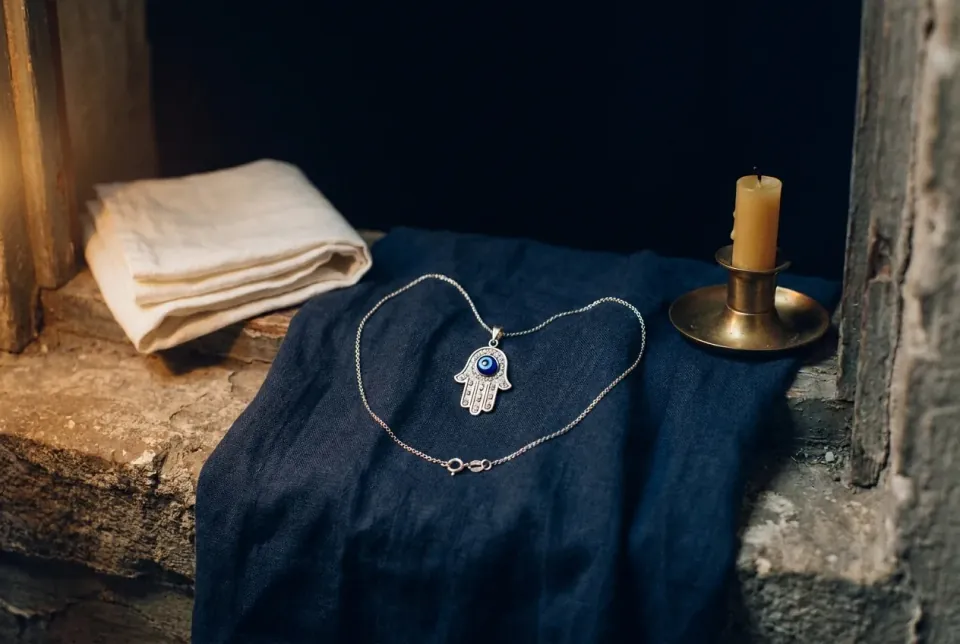
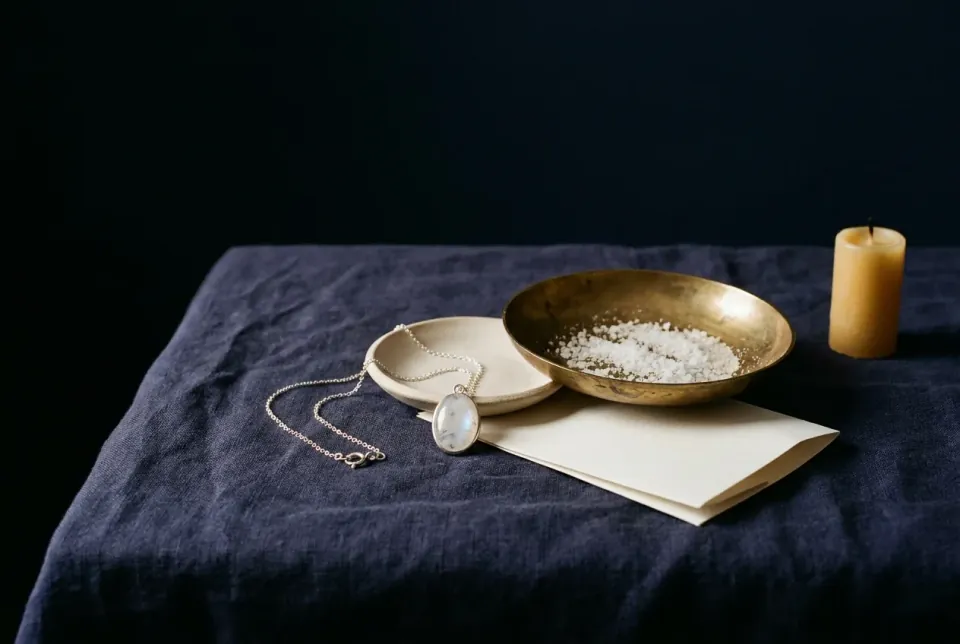
A silver pendant, a square of paper and a shallow brass bowl sit on ink-blue cloth. The salt stays in the bowl. The necklace rests beside it, its chain open and its clasp visible. Nothing is hidden under crystals or smoke.
I begin this ritual with a strict rule: one piece, one intention. The rule makes the table look almost bare. That is the point. A new moon practice does not need a crowded altar to feel alive. It needs enough quiet for one honest sentence to be heard.
The September 2026 new moon arrives on September 11 at 03:27 UTC, according to Timeanddate.com’s September 2026 phase table. You do not need to wake at the exact minute. Use the evening of September 10 or 11 in your time zone, whichever gives you an unrushed half hour.
This ritual charges one wearable object, then carries its intention through 28 days. It is not a spell for controlling an outcome. It is a way to make your chosen direction tangible: written once, spoken clearly and touched in ordinary life.
The dark moon is a beginning without a spotlight
At new moon, there is almost nothing to see. NASA describes it as the invisible phase: the Moon’s illuminated side faces the Sun while its night side faces Earth. The Moon rises and sets near the Sun, so waiting for a bright lunar beam at midnight misses the physical reality of the phase.
The astronomy and the ritual belong in different lanes. Astronomically, new moon names a position in a repeating sequence. Spiritually, contemporary moon practice treats that darkness as a threshold. The empty-looking sky gives an intention room to begin before it has proof, momentum or applause.
People have watched the sky to navigate and mark time across millennia. The Metropolitan Museum of Art’s survey of art and the night sky notes how celestial motion shaped days, years and the idea of a month. That broad history does not create one universal new moon ritual. This particular practice is contemporary and deliberately simple.
A full lunar phase cycle lasts about 29.5 days, not 28, as NASA’s phase guide explains. The 28 days below are a practice container. Starting on September 11, Day 28 falls on October 8, two days before the next new moon on October 10. Those final quiet days leave space to close the practice before deciding what comes next.
Choose the piece that can carry an ordinary month
Pick jewelry you can realistically wear most days. A small ring, bracelet or pendant usually works better than a ceremonial piece that spends the week in a box. The object should be easy to touch without looking and comfortable enough to remain present while you work, travel, cook or speak with someone you love.
Let the intention choose the piece. A ring keeps returning to your field of vision and suits an intention connected with action. A bracelet moves at the pulse and is easy to touch before a decision. A pendant can rest near the heart or throat, close to feeling or speech. If you need help matching form, symbol and daily life, begin with the guide to choosing spiritual jewelry.
Check the physical object before assigning it 28 days of wear. Tug the clasp gently. Look for a loose jump ring, frayed cord, lifting plating or a stone that shifts in its setting. The Gemological Institute of America explains that gem durability includes hardness, toughness and stability, and that different stones tolerate heat, light, chemicals and humidity differently. Follow the care needs of the whole piece, not only its most durable stone.
Clean it physically only in the way its maker or a qualified jeweler recommends. If it also feels energetically crowded, use a dry, material-safe method from our guide to cleansing and charging spiritual jewelry. Sound, a soft cloth and focused intention are enough. The ritual loses nothing by being gentle.
Write one intention that can guide behavior
Take a small piece of unlined paper. Write by hand if that is accessible to you. Keep the sentence short enough to remember without opening the fold.
Use the present tense and name a quality you can practice. These work:
- I speak with clarity and kindness.
- I protect time for the work that matters.
- I receive support without abandoning my own judgment.
- I meet change with a steady heart.
Avoid stacking five desires into one sentence. “I welcome love, money, health, a new home and perfect confidence” gives the jewelry nothing clear to return you to. Choose the root. Perhaps the deeper intention is receptivity, steadiness, courage or honest action.
Keep the sentence within your own field of choice. An intention such as “I recognize mutual love and respond openly” leaves another person’s will intact. “This person chooses me” does not. Jewelry can carry your promise. It should not be asked to override consent, replace a conversation or guarantee what another human will do.
Read the sentence once. Then ask one practical question: What would this intention change tomorrow? This is the article’s only question because the answer matters more than a page of affirmations. Add one small action beneath the sentence, such as blocking thirty minutes for a proposal, declining one draining invitation or making the call you have postponed.
Build the salt bowl without touching the jewelry
Pour a thin layer of dry salt into a shallow bowl. Treat the salt as the ritual’s boundary: a simple material that holds the idea of clearing and preservation. Do not treat it as a jewelry-cleaning product.
Place a folded cloth, small ceramic dish or closed jewelry box beside the salt bowl. Set the piece there. If you prefer the visual of the jewelry above the bowl, span the top with a stable saucer that cannot tip. The salt and jewelry must remain physically separate.
This separation is not fussy. The Canadian Conservation Institute warns that dissolved salts can accelerate metal corrosion and that chloride salts are especially destructive. Finished jewelry may combine silver, copper alloys, plating, solder, adhesive, thread and porous stones. Do not bury it in salt, sprinkle salt over it or place it in salt water.
Set the folded intention beneath the jewelry’s separate dish. The arrangement now has three clear parts: salt for the boundary, paper for the direction and jewelry for the daily return.
Charge the piece with breath and words
Sit with both feet supported or choose any posture you can keep without strain. Leave the candle unlit if fire would distract you. The dark is already doing its work.
- Arrive with three breaths. Inhale gently for a count of four and exhale for six. Repeat three times. If counting makes the breath tight, let it move naturally instead.
- Name what is complete. Hold your hands near the bowl without touching the salt. Say, “I release the habits that pull me away from this intention.” You do not need to list them all.
- Lift the jewelry. Hold it in one or both hands. Notice its weight, temperature, edges and moving parts. Let the actual object interrupt vague thinking.
- Speak the sentence three times. Use the same words you wrote. On the first reading, hear them. On the second, imagine one ordinary action that expresses them. On the third, feel the piece in your hand.
- Give the piece one job. Say, “When I touch this, I return to my intention.” This is the hinge of the ritual. The jewelry becomes a cue you can meet during the day.
- Put it on slowly. Fasten the clasp or settle the ring. Take one final breath. Place the piece back on its dish overnight if you do not sleep in jewelry.
Leave the paper folded beneath the dish until morning. Dispose of the salt in household waste or return it to the kitchen only if it remained clean and untouched. Do not consume salt that has held incense ash, candle wax, oils or other ritual materials.
Carry the intention for 28 days
Charging is the beginning. Repetition turns the object into practice.
Each morning, put on the piece and speak the sentence once. During the day, touch it when you meet a choice related to the intention. Do not rub it anxiously for reassurance. Pause, feel the object and choose the next congruent action. At night, remove it with care and record one line: “Today I returned when…” or “Today I forgot when…” Both are useful.
The September sky gives the 28 days a clean rhythm. The exact September phase moments below come from Timeanddate.com’s current guide, while NASA’s 2026 visualization shows that the Moon changes continuously between them.
Days 1–7, September 11–17: protect the seed. Keep the intention private if explaining it too soon would thin it out. Make one small supporting action each day. The work here is consistency, not display.
Days 8–15, September 18–25: build visible structure. First quarter occurs on September 18 at 20:43 UTC. Let the growing light correspond with commitment. Put the appointment in the calendar. Send the draft. Move the object from wish to behavior.
Days 16–22, September 26–October 2: see what the practice reveals. Full moon occurs on September 26 at 16:49 UTC. Read the original sentence. Notice where your conduct agrees with it and where it does not. Do not rewrite the intention just to avoid discomfort.
Days 23–28, October 3–8: release the extra. Last quarter occurs October 3 at 13:25 UTC. Remove one habit, obligation or distraction that competes with the intention. On Day 28, read all 28 lines and circle three moments when the jewelry brought you back.
Missing a day does not spoil the cycle. Put the piece on the next morning and continue with the numbered day. The ritual is a relationship with attention, not a streak designed to punish you.
Close before the next dark moon
On October 8, return the jewelry to its cloth beside the empty salt bowl. Read the intention once more. Then choose one of three endings: keep the sentence for another cycle, revise it because the practice clarified what you mean or fold it away because the work is complete.
If the piece is moonstone, the guide to moonstone necklace meaning offers a more specific threshold practice and material-care notes. Any suitable piece can carry this ritual, though. Its value lies in being close enough to meet your hand when the day becomes noisy.
The first night began with a nearly bare table. Twenty-eight days later, the objects look the same: one piece, one folded sentence, one bowl. What has changed is the number of times you returned. The charge lives there, in the quiet distance between choosing an intention and choosing it again.