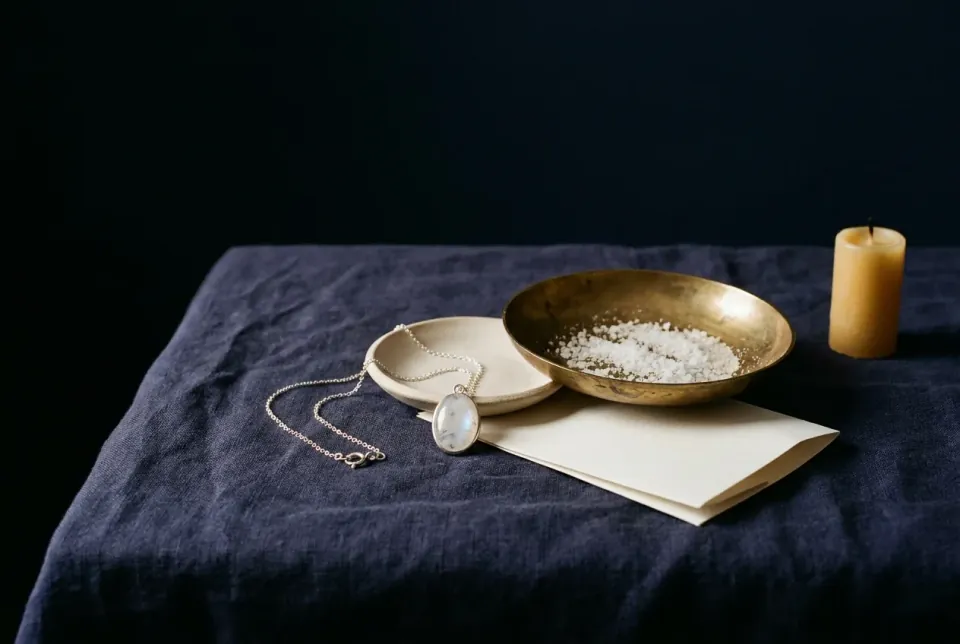
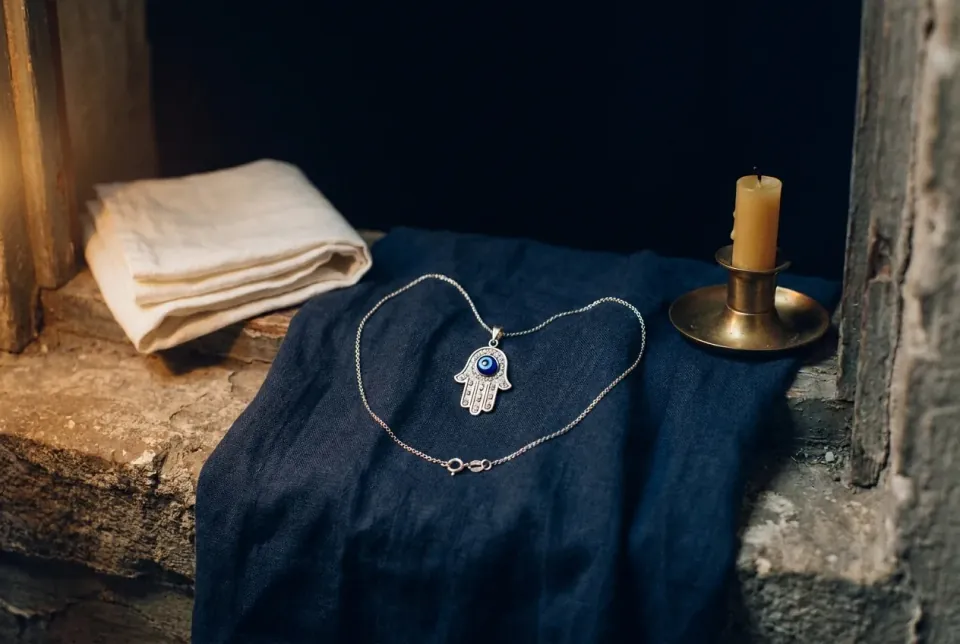
A new necklace lies open on a folded cloth. The clasp has not yet learned the small scratches of daily wear. At the center is either a blue eye looking outward or an open hand with five quiet fingers. Beside it, an unlit candle marks the edge between ordinary preparation and attention.
The doorway matters more than the candle. A threshold is where one space becomes another: street becomes home, private life becomes public life, intention becomes conduct. Protective jewelry belongs in that movement. It is not a wall around you. It is a small object that helps you notice what you are allowing across the line.
This ritual sets a new evil eye or hamsa piece into service, renews it once a month and gives you a calm process if it breaks. The spiritual work stays inside the traditions of protection, blessing and watchfulness carried by these amulets. The practical work stays close beside it: inspect the chain, name a real boundary and act on what you name.
Know which symbol you are holding
The evil eye is the harmful or envious gaze. The eye-shaped amulet worn against it is the protection, commonly called a nazar in Turkish contexts. A University of Kansas cultural resource describes the nazar boncuğu as an eye-shaped protective bead used in Turkey and places related evil-eye beliefs across the Mediterranean, the Middle East and beyond. Our evil eye necklace meaning guide follows the distinction in more detail: the blue eye at your chest is not the evil being invited in. It is the watchful sign placed against it.
The hamsa is an open-hand amulet. Its name is connected with the number five, and its histories live especially in Middle Eastern and North African Jewish and Muslim communities. It is called the Hand of Miriam in Jewish settings and the Hand of Fatima in Muslim ones. My Jewish Learning’s account of the hamsa also emphasizes that its precise origin is debated rather than owned by one tidy ancient story.
The eye and hand can appear together. That does not make them interchangeable. A hamsa remains the hand; an eye in its palm adds a protective eye motif. The hamsa necklace meaning guide explains the hand’s names, inscriptions and modern direction meanings without flattening their cultural contexts.
Museum objects make this regional history tangible. The British Museum catalogues a gilded copper-wire hand pendant from Gaza, dated to the early twentieth century and used as an amulet against the “eye of envy.” The Science Museum Group holds a Palestinian necklace from Hebron made with 49 glass eye beads, collected in 1930 and described as being worn to avert the evil eye. These are not generic spa symbols. They are material evidence of protective traditions carried through particular places and communities.
Begin by naming the piece correctly. If it includes Hebrew or Arabic writing you cannot read, identify the words before wearing them. Respect is not nervousness. It is the decision to let a living symbol keep its name.
Prepare the piece without damaging it
Set the jewelry on a clean cloth in good light. Before you ask it to hold an intention, inspect the object it actually is.
Trace the chain from one end to the other. Close and open the clasp once. Check whether the small jump rings meet cleanly, whether the pendant’s bail is secure and whether a stone or glass eye moves in its setting. Run a fingertip near the edges without pressing on them. Stop if you find a sharp burr, cracked glass, a spreading stone fracture or a loose prong.
Jewelry has always joined adornment to functions such as status, devotion and protection; the Victoria and Albert Museum’s survey of jewelry history shows those roles recurring across periods and cultures. Spiritual purpose, however, does not strengthen a thin jump ring. Have structural problems repaired before beginning.
Clean only by a method suited to every material in the piece. A soft dry cloth is the safest default when you do not know whether the metal is plated, the eye is glued or the stone is porous. Do not soak finished jewelry in salt water, coat it in oil or pass delicate cord over smoke. For other gentle options, use the material cautions in our guide to cleansing and charging spiritual jewelry.
The ritual needs four things:
- the jewelry;
- a clean cloth or dish;
- an unlit candle, if you want a visible marker;
- one sentence that names the boundary you mean to keep.
Leave the candle unlit if flame is inconvenient. Protection does not become stronger because wax is burning.
Set the threshold before you cross it
Choose a doorway you use regularly. Your front door is direct, but a bedroom, studio or office doorway works when the practice concerns rest, creativity or work. Clear the floor so the chain cannot be stepped on if it slips.
Place the folded cloth just outside the room. Set the necklace or bracelet on it with the symbol facing upward. Stand on the outside as well. Take three unforced breaths and notice what you are about to enter.
Now write or speak one boundary. Keep it within your own choices. These are strong enough:
- I do not carry every mood that enters the room.
- I share good news where it will be held with care.
- I can be kind without making myself endlessly available.
- I listen to my first clear no.
Avoid naming an enemy or asking the amulet to punish someone. Protection is cleaner when it turns your attention toward discernment rather than suspicion.
Lift the piece in your palm. If it is a nazar, let the eye face outward for a moment. If it is a hamsa, notice the open palm: a boundary that has not become a fist. Say:
Keep watch at the edge of what is mine. Let envy, pressure and confusion pass without taking root. Keep my sight clear, my heart open and my no close enough to speak.
Step across the threshold. Pass the jewelry from your outward-facing hand to the hand nearest your chest, then put it on. This motion is the hinge of the ritual: from outside to inside, from symbol to wearer, from a sentence to a choice.
Touch the pendant once. Name the real action that will keep the boundary today. Mute the chat. Delay the announcement. Leave the gathering at the time you chose. Ask for privacy. The amulet reminds you; the action closes the circle.
Wear protection without feeding fear
For the first seven days, touch the piece only when a boundary is actually present. Let the contact be brief. Feel the metal or glass, repeat the sentence once and decide what the moment needs.
Do not check the charm every few minutes for signs that danger is near. A protection practice that makes you scan every face for envy has begun serving fear. Bring it back to watchfulness by separating what belongs to you from what does not, then choosing the response that is yours to make.
You can wear the piece visibly or under clothing. An outward-facing nazar suits the symbol’s watchful role, but a pendant turning on its chain does not cancel the practice. Hamsas also appear in more than one orientation; modern jewelry commonly gives upward and downward hands different readings, but no universal rule makes one direction spiritually valid and the other inert.
When you take the jewelry off, place it somewhere deliberate rather than dropping it in a tangle. The daily gesture teaches care without turning the object into something fragile or frightening.
Renew the practice once a month
Choose a date you will remember: the first evening of the month, a new moon, or the date you first dedicated the piece. Monthly renewal is a rhythm for attention, not an ancient requirement shared by every hamsa or evil-eye tradition.
Begin with the physical check. Look at the clasp, chain, bail and setting. Wipe the piece safely. If the month included conflict, travel or emotional strain, use sound, prayer or breath rather than a risky bath. Set the jewelry on its cloth beside the unlit candle.
Read the original boundary aloud. Then ask the ritual’s one question: Did my actions protect what I said mattered?
Name one moment when they did and one moment when they did not. No punishment. Adjust the sentence only if your understanding has changed. A boundary that began as “I keep everything private” may mature into “I share slowly with people who have earned trust.”
Carry the piece across the same threshold and speak the protection words again. Finish with one concrete action for the new month. Renewal should make your conduct clearer, not make the ceremony larger.
If the protective jewelry breaks
A broken nazar or hamsa can feel like an event, especially after an intense conversation, journey or change. Some living traditions read a broken eye amulet as having taken or absorbed a harmful force; the University of Kansas overview records that interpretation for the Turkish nazar. Receive that reading as tradition, not as proof that an unseen disaster was moments away.
First, gather every part. Put the chain, charm and fragments in a small dish. Do not wear a cracked glass eye, loose pendant or sharp metal edge. Inspect the clasp, jump ring, bail, chain and setting. A failed component can explain the break even when the timing still feels meaningful.
Then separate three statements:
- The physical fact: “The jump ring opened.”
- The spiritual feeling: “This happened at the end of a difficult season.”
- The next act of care: “I will have it repaired,” or “I will let this piece rest.”
You have four sound choices. Repair the piece when its work feels unfinished and the material can be made safe. Cleanse and rededicate it when the break feels like accumulated heaviness rather than an ending. Retire it when completion feels honest. Replace it when the symbol still belongs in your practice but the object no longer can.
Do not bury an assembled necklace or throw glass and metal into water. Keep the pieces, reuse an intact charm, ask a jeweler about repair or dispose of damaged components responsibly. Our guide to the spiritual meaning of jewelry breaking offers a fuller process for repair, remaking, release and rest.
If you retire the piece, place it on the cloth one last time. Thank it for the boundary it helped you remember. Speak the original sentence without wearing anything. That final step matters: it returns protection from the object to the person who practiced it.
Leave the doorway open
The necklace began outside the room, new and unscratched. After a month, it may carry a faint mark near the clasp or the warmth of being touched at the right moment. The symbol has not built a fortress. It has become familiar enough to interrupt you before an automatic yes, an unnecessary disclosure or a fear borrowed from someone else.
An eye watches. A hand blesses and stops. You cross the threshold carrying both meanings, but the deepest protection is the clarity that crosses with you.