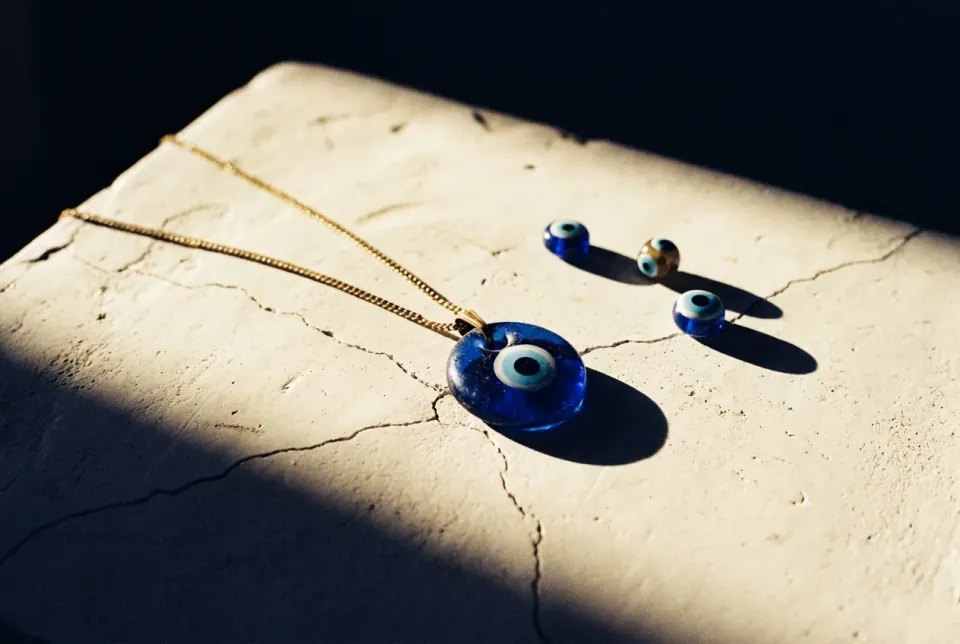
The evil eye is the harmful gaze. The eye-shaped charm worn against that gaze is a protective amulet, often called a nazar. This distinction changes the meaning of the necklace: the little blue eye at your chest is not evil. It watches the boundary around you and turns unwanted attention away.
Worn as a necklace, the symbol moves with your breath and rests near the heart. You can touch it before entering a crowded room, answering an intrusive question or sharing news that still feels tender. Its protection works best alongside the boundaries you speak and keep.
What an evil eye necklace protects against
The evil eye belief holds that a charged look can carry envy, resentment or ill will. A nazar gives that danger a visible counter-symbol. The eye looks back.
This belief crosses many regions and religious settings. A mindbodygreen overview of the evil eye describes traditions across Europe, North and East Africa, the Middle East, the Philippines and Latin America. In Mediterranean Italy, the harmful gaze is the mal’occhio, and protective horn amulets appear beside eye beliefs. In Morocco, the harmful eye may be called al-ayn, and an outward-facing palm also appears in protective practice. These examples show wide reach, not one neat birthplace.
Jewelry has carried protection for a very long time. The Victoria and Albert Museum’s history of jewelry notes that early adornment was likely worn partly against life’s dangers, and that medieval European jewels could bear inscriptions believed to protect the wearer. That broader history helps place the nazar within an enduring human impulse: we put meaning on the body when we want care to remain close.
Within spiritual practice, an evil eye necklace can guard against envy, projection and the feeling of being watched too closely. It can also return your own attention to what belongs to you. Protection is steadier when it is built from discernment rather than fear.
The nazar and the hamsa are different symbols
A nazar is usually an eye-shaped amulet, often made as concentric circles or drops of blue, white and black glass. A hamsa is an open hand. My Jewish Learning documents hamsas with an eye embedded in the palm, which is why product descriptions sometimes blur the names.
The forms still have separate identities. The eye set inside a hand is one motif within a hamsa. A standalone blue eye is a nazar. The hamsa necklace meaning guide explains the Hand of Fatima, Hand of Miriam and the debated history of that open-hand amulet.
The language matters because these symbols come from living cultures. Calling every hand, eye and protective charm an “evil eye” erases the visual and religious contexts that make each one legible.
Why wear the amulet as a necklace?
A nazar over a doorway watches the threshold of a home. One hanging in a car travels with the vehicle. A necklace brings the protective boundary to the body.
Its position near the heart can make protection feel intimate rather than defensive. The chain rises around the throat, an area connected in spiritual practice with speech and truth. The pendant rests where the chest can feel its small movement. This gives you a physical cue to notice when you are oversharing, agreeing from pressure or absorbing a mood that did not begin with you.
Chain length has no universal protective law. A short pendant near the collarbone stays visible and can feel outward-facing. A longer pendant may disappear under clothing and become a private talisman. Choose the placement that lets you reach the piece naturally.
If the concentric eye draws you toward pattern and proportion, the guide to sacred geometry jewelry offers a separate look at circles, triangles, mandalas and tradition-specific sacred forms. Visual similarity alone does not make every geometric design a nazar.
Blue evil eyes and modern color meanings
Blue is the color most closely associated with the familiar nazar. It appears so often that a small blue-and-white eye can be recognized from across a room. The historical record varies by place, however, and there is no single color chart shared by every evil eye tradition.
Contemporary jewelers now make the symbol in many colors. Modern spiritual readings often connect pale blue with calm communication, green with growth, red with courage, white with clear beginnings and black with firm boundaries. These are present-day interpretations, not ancient universal codes. Let color refine your intention, but do not mistake a retailer’s chart for cultural history.
Materials change the way the necklace feels. Glass holds the classic concentric look. Enamel creates a flatter, cleaner surface. A tiny gemstone eye can be discreet enough for daily wear. Inspect the chain, clasp and setting before asking the piece to accompany you everywhere. A protective symbol still needs sound construction.
Set a protective intention that includes real boundaries
Hold the necklace in both hands before you put it on. Feel the chain settle across your fingers, then name one place where your energy needs a clearer edge. Keep the intention specific.
You might be preparing to share a creative project before it feels fully rooted. You may be entering a family gathering where personal questions arrive quickly. Perhaps you simply want to move through public space without carrying every expression you meet.
Take one slow breath and say:
May this eye keep watch at my boundary. Let what is mine remain clear, and let what is not mine pass without entering.
Fasten the necklace. Then choose one action that gives the intention a body: delay the announcement, leave the conversation when it turns invasive, silence the group chat for an hour or answer a question with a clean “I would rather keep that private.” The pendant reminds you. Your choice maintains the boundary.
For a fuller first-wearing practice, use the threshold protection ritual for evil eye and hamsa jewelry, which includes a monthly renewal and a calm process for breakage.
For a wider look at stones and symbols used in this kind of practice, see protection jewelry for women.
Wearing and gifting the evil eye respectfully
Anyone can wear a nazar when the choice begins with understanding. Learn the name of the amulet, recognize the harmful gaze as the evil eye, and avoid presenting the symbol as a trend you discovered. If it belongs to your family or community, you may carry layers of memory that another wearer does not. If it comes to you through admiration, let that admiration include care.
Gifting has a natural place in protective jewelry. The gesture says, “May you be watched over.” Choose the material and scale for the recipient’s actual life. A glass charm on a delicate chain may suit someone who wears small necklaces. A child needs age-appropriate construction and supervision. A person who does not share the belief may prefer to receive the cultural story with the gift rather than an assumption about what they should wear.
The amulet can face outward as part of its watchful symbolism. Most eye pendants already appear forward-facing by design. If a double-sided pendant turns during the day, there is no need to keep correcting it. Protection does not depend on a chain staying perfectly still.
If an evil eye necklace breaks
A broken protective necklace can feel charged, especially if the chain parts during an intense period. Pause before deciding what the break means.
Check the clasp, jump ring, chain and pendant. Fine links stretch. Clasps fail. Glass chips when it strikes a hard surface. Ordinary wear can be the whole physical explanation, and the moment may still carry meaning for you.
Spiritually, several readings are possible. You may feel that the necklace completed a protective cycle, met an energy it could no longer carry or marked the end of a chapter. You may also feel nothing beyond the wish to have it repaired. No single omen applies to every broken nazar.
Place the pieces in a small dish so none are lost. Sit with your first body response. Relief may suggest completion. Tenderness may ask for repair. A heavy feeling may call for cleansing before you decide. The guide to the spiritual meaning of jewelry breaking gives a fuller process for choosing whether to repair, remake, retire or keep a broken piece.
Evil eye necklace questions
Can anyone wear an evil eye necklace?
Yes. Wear it with an understanding of the nazar’s protective purpose and the many cultures that have held evil eye beliefs. Respect does not require pretending every tradition tells the same origin story.
Should the evil eye face outward?
An outward-facing eye fits the amulet’s watchful meaning, and most pendants are designed that way. A necklace turning on its chain does not cancel its protection.
Can I give an evil eye necklace as a gift?
Yes. It is a natural gift for protection, especially when you explain why you chose it. Avoid using fear to sell the gesture. A blessing feels warmer than a warning.
What does it mean when the necklace breaks?
It may feel like protection fulfilled, accumulated charge or a completed cycle. It may be a worn jump ring. Inspect the object first, then listen for the reading that fits the moment without forcing one.
The most useful touchstone comes when you reach for the eye and remember your own sight. You notice the room, the pressure in your chest and the answer you want to give. The pendant keeps watch. You decide what may come closer.