Lift your palm and the body already knows several meanings. Stop. Stay back. Welcome. Receive this blessing. The hamsa turns that familiar gesture into an amulet worn for protection and good fortune.
A hamsa necklace places the open hand at the throat or chest, where a boundary can remain visible without closing the heart. Its meaning comes through Jewish and Muslim traditions, along with older possible precedents that scholars continue to debate. It is known as the Hand of Miriam and the Hand of Fatima. An eye may appear in the palm, but the hamsa itself is the hand.
Five fingers, several histories
The name is connected with the Arabic khamsa, meaning “five.” My Jewish Learning’s history of the hamsa links the word to the amulet’s five-fingered form and describes one prominent early example: a large open hand on the Gate of Judgment at the Alhambra, the 14th-century Islamic fortress in southern Spain.
That example does not settle the symbol’s beginning. The same source explains that scholars have variously interpreted the hamsa as Jewish, Christian, Islamic or connected with pagan fertility symbolism. Open-hand images also appear in far older settings. Similarity can suggest a precursor without proving a direct line of descent.
The uncertainty is part of an honest account. The hamsa gathered meaning as communities lived beside one another, carried forms across regions and placed their own prayers inside the hand. A single ownership claim would flatten that history.
In Muslim contexts, the Hand of Fatima refers to Fatima, daughter of the Prophet Muhammad. In Jewish contexts, the Hand of Miriam refers to Miriam, sister of Moses and Aaron. My Jewish Learning describes the amulet as significant to both Jews and Muslims and notes its strong association with Sephardic Jewish culture. Today it appears on necklaces, wall hangings, mezuzahs, key chains and other objects.
Read the details inside the hand
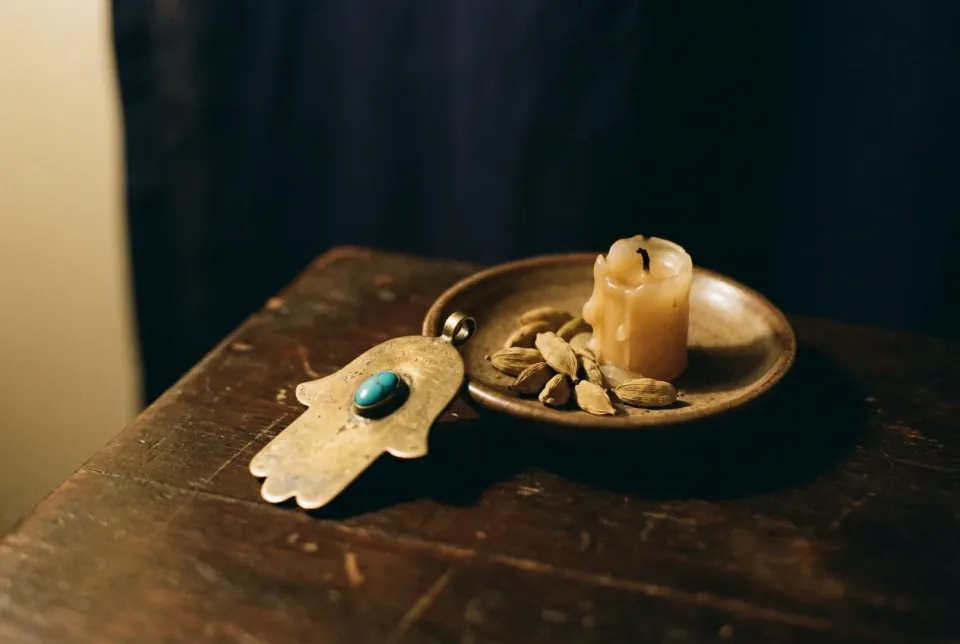
Hamsas vary more than their small size suggests. Some look like a natural hand, with a thumb on one side and a little finger on the other. Others are symmetrical, with a second thumb replacing the little finger. The fingers may be spread, held close together or reduced to a simple outline.
The palm often carries another symbol. Each addition changes the emphasis.
The eye
An eye in the palm is used against the evil eye, the harmful gaze associated with envy or ill will. The hand and eye work together as a protective composition. This eye does not turn the hamsa into a standalone nazar.
A nazar is an eye-shaped amulet, most familiarly blue and made from concentric shapes. A hamsa is hand-shaped. The evil eye necklace guide follows that distinction through wearing, color and breakage.
Fish and Jewish inscriptions
My Jewish Learning documents fish on some Jewish hamsas and connects them with a Talmudic teaching that fish are protected from the evil eye because water covers them. Other hamsas may include the Star of David, the Shema, a traveler’s prayer or a blessing for the home. Read these as Jewish motifs grounded in text and ritual.
Flowers, geometric patterns and stones
Contemporary hamsas may carry flowers, hearts, filigree, gemstones or repeated line work. These choices can make the hand feel tender, ornate or strongly graphic. They do not create a new ancient meaning. If the pattern itself is central to your practice, the sacred geometry jewelry guide explains how circles, mandalas and tradition-specific diagrams carry meanings of their own.
Does an upward or downward hamsa mean something different?
Modern jewelry descriptions commonly read an upward-facing hamsa as protection, a palm raised to meet harmful energy. A downward-facing hand is often associated with blessing, welcome, abundance or the flow of good fortune.
These are useful contemporary readings rather than a fixed ancient law. Historical hamsas appear in varied positions and settings, and the listed cultural sources do not establish one required direction for a necklace. Choose through the gesture you want to carry.
An upward hand can suit a season of firmer boundaries. It has the clean feeling of “enough” when your time or attention has been treated as endlessly available. A downward hand may fit a period of receiving, hospitality or trust. The fingers point toward the heart or earth, and the palm can feel like a blessing being poured into daily life.
Pendant construction matters too. Some hamsas hang from a bail at the wrist and remain upright. Others attach at the fingertips and face down. A reversible pendant may turn. None of these designs is spiritually defective. The piece should rest well, avoid catching on fabric and give you a shape you understand.
The protection of an open hand
The hamsa holds a useful tension. Its palm creates a boundary while staying open. This is protection without making hardness the goal.
That distinction matters when spiritual protection begins to feel like constant scanning for danger. A necklace can return you to discernment. It cannot speak the boundary, leave the room or decline the invitation for you. The hand at your chest can remind you to do those things before resentment gathers.
The guide to protection jewelry for women places the hamsa beside other symbols and stones used for grounding, social boundaries and travel. Choose the form that meets the kind of protection you actually need.
A hamsa blessing for boundaries and openness
Use this ritual before a difficult conversation or at the beginning of a week when you need both steadiness and warmth.
Lay the necklace across your left palm. Cover it lightly with your right hand. Notice the two gestures your hands are making: one receives, one protects.
Breathe into the center of the chest. Name the boundary that needs care in one plain sentence. “I will not explain this decision again.” “I can listen without taking responsibility for her reaction.” “My work may be seen without becoming available to everyone.”
Turn the hamsa so its palm faces outward and say:
May this hand guard what is tender and welcome what arrives in love. Keep my heart open, my sight clear and my no within reach.
Put on the necklace. Touch the palm once when the moment comes. Let that touch lead to a real response rather than a longer ritual.
Wearing a hamsa with cultural care
Start by naming the piece accurately. A hamsa is not generic “boho” imagery, and an eye in its palm does not make the whole symbol a nazar. Learn which motifs your pendant contains. Hebrew prayers, the Star of David and references to Miriam place a design in a Jewish context. The Hand of Fatima name places it in an Islamic context.
The Victoria and Albert Museum notes that jewelry has long expressed protection, rank, devotion and ritual meaning. Those meanings are carried by people, not detached from them when an object reaches a shop display. Wearing a hamsa respectfully means allowing its history to stay visible.
A person outside Jewish or Muslim traditions can wear a hamsa with informed appreciation. Avoid claiming authority over a community’s practice or inventing a universal origin. If the pendant includes a prayer you cannot identify, learn what it says before placing it on your body.
For a broader field guide to symbols, stones and personal talismans, see spiritual necklaces and their meanings.
Giving a hamsa necklace
A hamsa makes a natural gift for a move, marriage, trip, new child or demanding transition. The open hand can carry the wish that someone be protected and met by good fortune.
Match the design to the recipient’s relationship with the symbol. A Hand of Miriam with Hebrew text may be deeply appropriate for one person and puzzling for another. A Hand of Fatima may carry family resonance that deserves the right name. A simple open-hand form can still be offered with the story of why you chose it.
Include a short note. “May you feel protected in your new home” is enough. Fear does not improve a protective gift.
Questions about hamsa necklaces
Is the hamsa religious?
It has religious and cultural significance in both Jewish and Muslim contexts, and its earlier origins remain debated. Many people also wear it today as a protective or cultural symbol. The particular name, inscription and motif on a pendant can make its context more specific.
Can anyone wear a hamsa necklace?
Yes, with understanding and respect. Learn the symbol’s names, avoid reducing it to trend language and identify any prayer or sacred motif in the design.
What does the eye in the palm mean?
The eye is commonly placed there to counter the evil eye. It adds a watchful protective motif to the open hand. The eye and the hand remain distinct symbols within the combined design, as the cross-cultural evil eye overview from mindbodygreen also illustrates.
Which direction should the hamsa face?
Choose the gesture that fits your intention. Upward is often read today as protection; downward as blessing, welcome or abundance. Treat that as contemporary symbolic language, not a compulsory ancient rule.
A small hand resting against the sternum can teach a precise form of openness. The palm remains receptive. The fingers still mark an edge. When your own hand reaches for the pendant, it can remember the same shape.