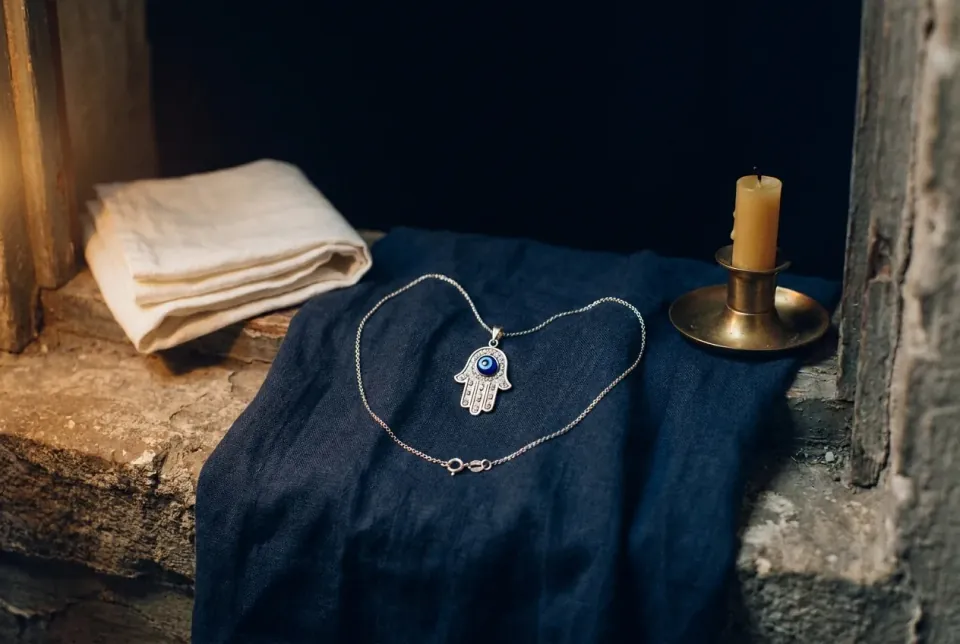
A pendant lies on a folded square of ink-blue cloth. Beside it sits a blank slip of paper and an unlit candle. The arrangement is small enough for a windowsill. Nothing needs to be buried, soaked or covered in smoke.
The piece may have been present through a hard conversation, a month of crowded trains or a decision that took too long. Jewelry does not need to store those events as measurable energy for the ritual to matter. It only needs to have been there. Its familiar weight can hold memory, and removing it can mark an ending with more clarity than another thought in a busy mind.
The October 2026 full moon reaches its exact phase on October 26 at 04:11 UTC, according to Timeanddate.com’s October 2026 phase table. Use the evening of October 25 or 26 in your location. The ritual takes about 25 minutes before the overnight rest, and it works with one piece.
This is a contemporary spiritual practice, not an ancient ceremony with one universal lineage. It pairs the visible fullness of the lunar cycle with a simple act of completion: clean the object safely, name what has finished, remove the piece and leave it at rest.
What the full moon changes, and what it does not
Astronomically, full moon is a precise relationship among the Sun, Earth and Moon. NASA explains that the Moon stands opposite the Sun from our viewpoint, revealing almost all of its illuminated dayside. A full moon rises around sunset and sets around sunrise. It can look full for a couple of nights, although the exact phase is one moment.
Moonlight is reflected sunlight. It does not physically draw emotion from metal or wash a gemstone clean. The cleansing in this ritual belongs to spiritual practice: you give attention to what the jewelry represents, then use a visible cycle to close that chapter.
Full moons have carried religious and symbolic importance in many cultures, but that broad fact does not make every modern moon ritual ancient. Encyclopaedia Britannica notes that full-moon observances appear in Hinduism, Buddhism and contemporary Neo-Pagan practice. Those traditions are not interchangeable. The sequence below does not borrow a named rite from any of them. It is a modern personal ritual built around attention, release and safe care.
The distinction protects both honesty and meaning. You can treat moonlight as sacred without making a scientific claim for lunar energy. You can also use the ritual as a structured pause without adopting a belief that does not belong to you.
Choose one piece, not the whole jewelry box
Pick the piece most closely connected with what you are ready to set down. It may be a ring worn through a demanding project, a bracelet tied to an old promise or a pendant that became a steadying touch during a difficult month.
Do not choose the most expensive piece merely because the full moon feels important. Choose the object whose absence tomorrow would be noticeable. The ritual uses removal as its central action, so daily familiarity matters.
Inspect the jewelry before you begin. Check the clasp, jump rings, prongs, cord and stone setting. If anything is loose, sharp or cracked, stop wearing it and place every part in a closed dish. Our guide to the spiritual meaning of jewelry breaking begins with the physical cause before considering symbolic meaning.
If the piece carries a new intention rather than an ending, use the new moon intention jewelry ritual instead. A full moon release should not become a crowded list of wishes. Let it do one job well.
Clean the object without harming it
Spiritual cleansing does not replace physical care. Before the ritual, wipe the piece gently with a clean, soft cloth. Use water, soap or a specialist product only when the maker or a qualified jeweler confirms that the whole construction can tolerate it.
The whole construction matters. A durable stone can sit in a plated setting. A strong chain can hold a porous gem. Adhesive, silk thread, enamel and surface treatments each add their own limits. The Gemological Institute of America describes gem durability through hardness, toughness and stability, including resistance to light, heat, chemicals and humidity.
Keep this ritual dry. Do not put finished jewelry in moon water. Do not bury it in salt. Do not leave it outside where dew, rain, temperature change or a curious animal can reach it. A closed indoor window gives you the moonlit setting without asking the object to survive the weather.
Strong light is not harmless to every gem. GIA explains that prolonged light can fade or change materials including amethyst, kunzite, topaz and citrine. Long-term heat and light can also damage organic gems such as pearls and amber. Ordinary moonlight is far weaker than direct sun, but the practical rule remains useful: collect the piece before it sits in bright morning sunlight.
For a broader material guide, read how to cleanse and charge spiritual jewelry safely. When the materials are unknown, sound, a soft cloth and intention are safer than immersion.
Prepare the release
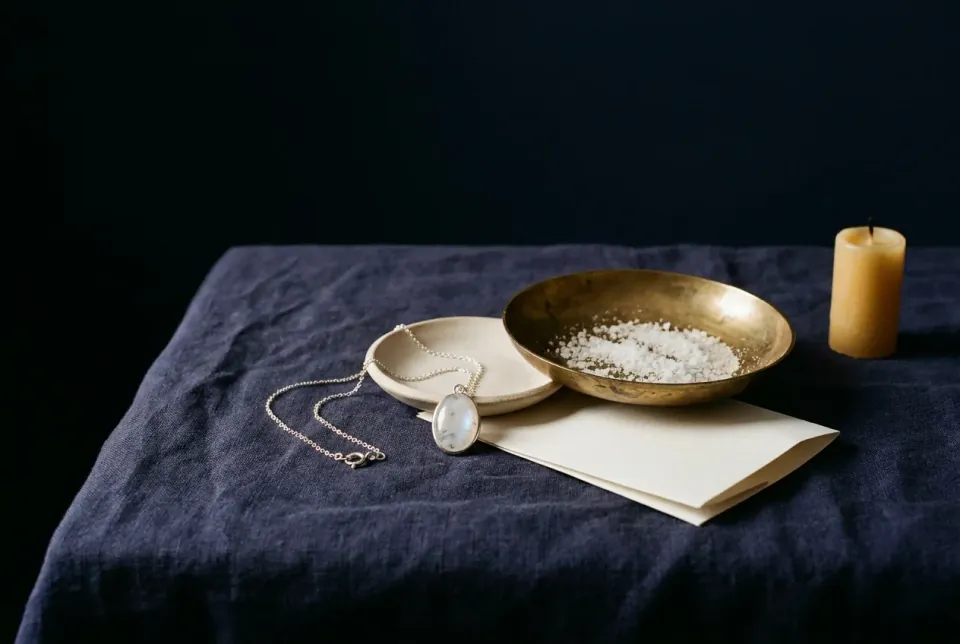
Set the jewelry on a soft cloth or in a shallow ceramic dish near a closed window. Place a blank slip of paper and a pen beside it. If you use a candle, keep it in a stable holder on a clear, fire-safe surface. The candle is optional.
Sit where your feet and back feel supported. Take three unforced breaths. Then touch the piece and recall the period it accompanied. Stay with concrete details. Name the room, task, habit or relationship. Avoid turning the ritual into a trial where you must prove that the month was bad enough to release.
Write one sentence beginning with these words:
I release my need to carry…
Finish it with something that belongs to your own choices. “I release my need to carry every decision alone” leaves room for action. “I release another person from behaving badly” tries to manage someone else through grammar. Keep the sentence inside your field of agency.
Under it, write one behavior that will make the release visible tomorrow. Ask for help. Remove the recurring appointment. Put the unsent message in an archive. Return the borrowed object. A ritual gains weight when the symbolic act meets an ordinary one.
Perform the full moon release
Move slowly through the sequence. Nothing improves when hurried.
- Clear the surface. Wipe the jewelry once more with the soft cloth. As you work, say, “I care for what is real and release what is complete.”
- Hold the history. Lift the piece and feel its weight, edges and temperature. Name aloud what it accompanied without blaming the object for the experience.
- Read the sentence. Speak your written release once. Pause long enough to hear the words rather than performing them.
- Remove the piece. If you are wearing it, unfasten it now. If it is already on the cloth, lift it to your body briefly, then set it down. Let the movement mark the boundary.
- Choose the next action. Read the practical behavior beneath the sentence. State when you will do it.
- Fold away from you. Fold the paper once, moving it away from your body. Place it beside the jewelry, not beneath a candle or against hot wax.
- Rest the piece. Leave the jewelry on the cloth by the closed window overnight. Direct moonlight is welcome, but it is not required. Cloud, curtains and buildings do not cancel the practice you have already completed.
If you want a spoken close, use plain words:
What has finished may leave. What remains, I will meet clearly.
Then step away from the window. Do not keep checking whether the Moon has reached the jewelry. The rest is part of the ritual.
Burn the paper only when fire is safe
Burning can make release feel final, but it is not the measure of a serious ritual. Tear the paper, recycle it or place it in household waste if flame is unsafe, restricted or likely to cause distress.
If you choose fire, take the paper outdoors where local rules allow it. Use a small fireproof bowl on a stable nonflammable surface. Keep water nearby. Tie back hair, avoid loose sleeves and never hold the paper as it burns. Light one corner, place it in the bowl and remain until every ember is cold. Do not burn coated paper, glitter, photographs, herbs, oils or unknown inks.
Keep the jewelry indoors and away from flame, ash and smoke. Soot is not energetic proof. It is residue.
You may burn the paper before the overnight rest or the following morning. If the emotion feels too large for a solitary ritual, do not force a dramatic ending. Fold the sentence, speak with someone you trust and return to the paper when your body feels steady.
Decide what happens in the morning
Collect the piece before strong sunlight reaches the window. Hold it for one breath, then choose one of three paths.
Wear it differently. Put the jewelry on after completing the practical action you wrote. The piece now marks the boundary rather than the burden.
Let it rest. Store it alone in a soft pouch or lined box for one lunar cycle. This is useful when the object still feels tightly connected to a finished role or relationship.
Release the object too. Repair, remake, gift, sell or responsibly recycle it. Do not donate broken jewelry with sharp edges or unstable settings. Do not give a symbolically loaded object to someone as a way to transfer unwanted emotion. Clean it, describe it honestly and let the next owner choose its meaning.
The ritual does not guarantee that grief, anger or attachment disappears by morning. Jewelry can support reflection, but it does not replace medical or mental-health care. What the practice can offer is a clear threshold and one action on the other side.
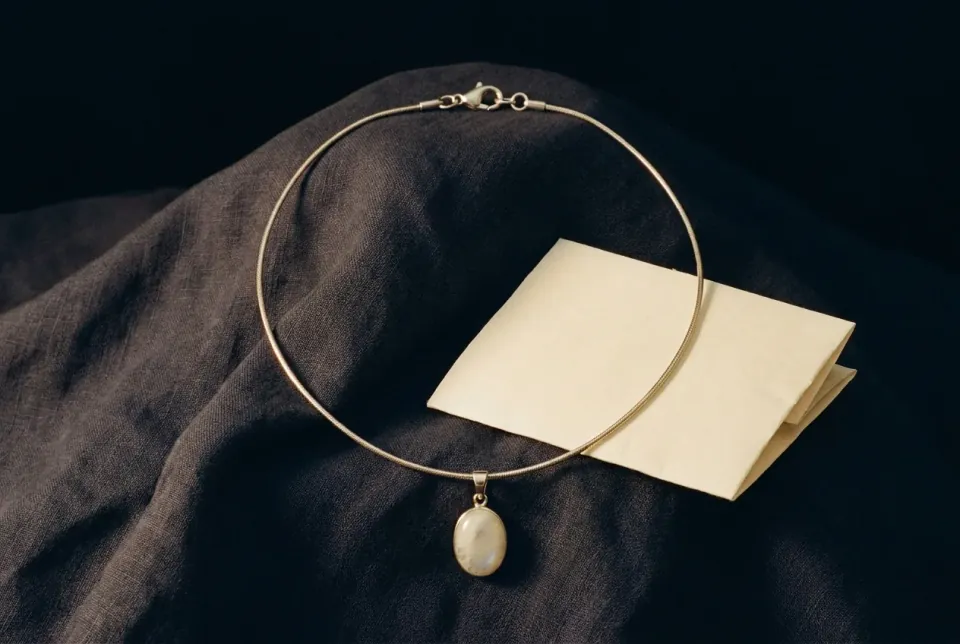
The pendant on the blue cloth has not changed its material. The chain has the same links. The stone holds the same inclusions. Yet the next time you fasten it, you can remember the night you stopped asking it to carry what was already over.