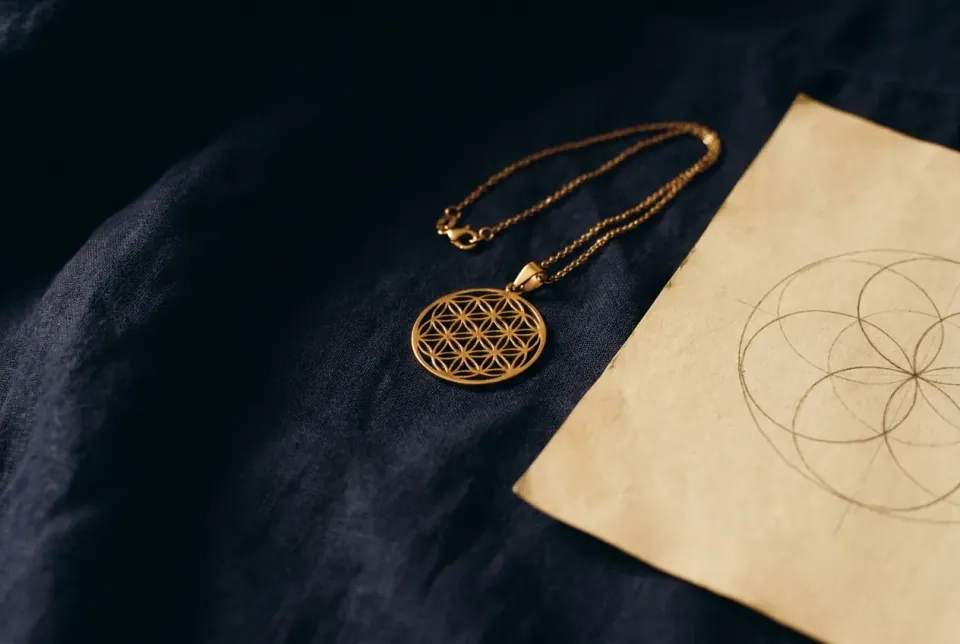
Set a compass point on paper. Draw one circle. Without changing the radius, place the point on the circumference and draw another. A lens appears between them. Move the point to the next intersection and repeat. Soon the paper carries six-petaled rosettes, hexagons and a field that seems to grow by its own rule.
Nothing was hidden in the compass. The surprise comes from how little the pattern asks of you: one radius, one repeated decision. That economy helps explain why overlapping circles have surfaced in distant places and periods. It does not prove that every maker shared one secret doctrine.
Today the familiar 19-circle arrangement is called the Flower of Life. It appears on pendants, altar cloths, tattoos and meditation cards, often accompanied by enormous claims about ancient Egypt, Leonardo da Vinci or a universal blueprint of creation. The pattern has a real and fascinating history. The cleanest way to honor it is to keep three things separate: the surviving marks, the geometry and the meanings contemporary practitioners give it.
First, name what is actually there
The Flower of Life is a finite portion of an overlapping-circles grid. In the common version, every circle has the same radius, and neighboring centers sit one radius apart on a triangular lattice. The central circle is surrounded by six, then by a second ring of twelve. That produces 19 circles. The grid can keep expanding beyond the border drawn around a pendant.
Wolfram MathWorld describes the construction as congruent circles whose centers lie on a triangular lattice. Complete hexagonal patches grow in centered hexagonal numbers: 1, 7, 19, 37 and onward. This is why the design feels floral without being a drawing of a flower. Curved lenses repeat around centers with sixfold order.
The lens made by two equal intersecting circles is commonly called a vesica piscis. Add circles at successive intersections and petals appear. Straight lines connecting neighboring centers reveal equilateral triangles and regular hexagons. The design holds curved and angular order at once.
That geometry is demonstrable. Claims that the full figure encodes every living form, every musical ratio or all five Platonic solids require additional constructions and interpretations. They belong to later sacred-geometry systems, not to the bare circle grid itself.
What the walls at Abydos can tell us
The Egyptian site most often attached to the Flower of Life is the Osireion behind the temple of Seti I at Abydos. The Egypt Exploration Society identifies it as the cenotaph of Seti I and records the long excavation history of the structure, from work begun around the turn of the twentieth century to Henri Frankfort’s clearance and publication.
The site is genuinely ancient. That does not automatically date every mark on its stone.
Photographs in the Dumbarton Oaks Abydos archive show graffiti in the pillared hall of the Osireion. The overlapping-circle figures associated with the Flower of Life are best treated in that category: marks added to the monument, not part of the formal carved and inscribed program that built it. Their exact date and maker remain uncertain.
That distinction changes the story. It is not sound to say, “Seti I’s builders carved the Flower of Life as their map of creation.” The evidence supports a narrower sentence: overlapping-circle figures appear on the Osireion’s granite, at an ancient sacred site visited and marked by people across later periods. The structure and the marks do not carry the same secure date.
Uncertainty is not a disappointment here. A wall can have more than one life. It can begin as royal architecture, become a place of ritual memory, gather visitors’ marks and later enter a global visual archive. The circles reached us through that layered history.
The pattern traveled because the method travels
An equal-circle grid does not require a measuring scale or a written key. A cord, divider or compass can carry the same radius from point to point. Each new intersection supplies the next center. Once the rule is learned, the design can migrate through workshops and across materials even when its name changes.
This helps us read related patterns without pretending they are identical symbols. The six-petal rosette, a seven-circle cluster, an extended circle lattice and the modern bounded 19-circle Flower belong to the same geometric family. A small rosette on an object is not necessarily an abbreviated statement of today’s Flower of Life teaching. It may be ornament, a construction grid, a workshop exercise, a protective mark or something whose local meaning is no longer recoverable.
Islamic geometric art offers a disciplined example of geometry as method rather than one universal emblem. The Metropolitan Museum of Art explains that compass and ruler generate circles and lines, which artists repeat into balanced systems of polygons, stars and interlaced designs. The circle may organize the finished pattern while disappearing beneath the visible strapwork.
This matters for cultural respect. Similar geometry does not erase difference. An Islamic girih design, a European compass rosette and a modern Flower of Life pendant may share a construction principle without sharing one theology.
What Leonardo actually studied
Leonardo da Vinci belongs in the history, but with a careful verb: he studied overlapping circles. He did not document the modern spiritual doctrine now attached to them.
The Museo Galileo catalogue describes the Codex Atlanticus as the largest collection of Leonardo’s sheets, spanning roughly 1478 to 1518 and containing scientific, technological, architectural and mathematical studies. Within that collection, MathWorld points to folio 309v for a related overlapping-circle construction.
Look at that evidence and a more human Leonardo appears. He is not receiving a finished mystical icon from an unbroken secret school. He is using circles as a workshop of thought: repeating them, testing relationships, and letting curved forms disclose triangles and hexagons. Geometry is active inquiry.
That is enough. Leonardo’s presence confirms that this family of patterns interested a Renaissance mind absorbed by proportion and construction. It does not certify every meaning later printed beside the image.
When it became the Flower of Life
The phrase familiar to contemporary spiritual shops belongs to a much later layer. Drunvalo Melchizedek’s The Ancient Secret of the Flower of Life, whose Google Books record lists the 1999 edition, helped carry the name and a broad creation narrative into modern New Age culture.
That publication history does not make the spiritual meaning false. It dates the language through which many present-day wearers encountered it. Ancient makers could use overlapping circles without calling the figure the Flower of Life. Modern practitioners can receive the pattern as a sign of unity without claiming that one interpretation governed Egypt, Assyria, Renaissance Italy and every later workshop.
Inside contemporary practice, the symbolism is easy to feel. Each circle remains complete while entering a larger field. No circle becomes the whole, and none is isolated. The pattern can therefore hold connection without sameness, creation through repetition, and the possibility that a life gains meaning through relationship.
Those are interpretations. Say so, then use them fully.
How the pattern moved onto pendants
Jewelry gives the grid a boundary. A maker usually cuts or casts the 19-circle field inside a larger circle, turning an indefinitely repeatable lattice into a wearable disc. Openwork versions let skin or fabric show through the lenses. Engraved versions keep the surface solid. Either way, the outer rim is not trivial. It gives the pattern an edge, a scale and a place on the body.
The pendant also changes how the geometry is encountered. On a wall or page, the eye travels outward. On a necklace, fingers tend to find the center. The symbol becomes tactile and private. Our broader guide to sacred geometry jewelry places the Flower of Life beside circles, triangles, mandalas and tradition-specific diagrams, while the field guide to spiritual necklaces explains how placement and form change the way a symbol is worn.
Construction quality matters because fine openwork has many potential snag points. Check that the outer rim is smooth, inner bridges are thick enough to resist bending and the bail is joined cleanly. A large disc needs a chain able to carry it without cutting into the neck. The practical checklist in our guide to choosing spiritual jewelry is more useful than any claim that geometry alone makes a poorly built pendant sacred.
A seven-circle practice for seeing clearly
You do not need a pendant to meet the pattern. Draw its first ring.
- Place a compass point near the center of unlined paper and draw one circle.
- Keep the radius unchanged. Put the point anywhere on the first circumference and draw a second circle.
- Move the compass point to one of the two intersections and draw again.
- Continue using new intersections until six circles surround the first.
- Stop at seven circles. Notice the petals, triangles and hexagon before adding a spiritual explanation.
- Write one word beside the drawing for a relationship you want to hold with more care.
- If you wear the pattern, touch its center once and remember that relationship.
This is a contemporary reflection practice, not a recovered Egyptian rite or a method attributed to Leonardo. Its honesty is part of its strength. You are using the same simple geometry while naming your own purpose.
The line worth carrying
Return to the compass. One circle began the field, but no circle completed it alone. The pattern grew because the same radius found a new center.
The Flower of Life does not need a false claim of one ancient, universal doctrine to become meaningful. Its documented history is richer: old monuments with later marks, workshops that understood repeating geometry, Leonardo’s searching pages, and modern practitioners who gave the lattice a new name. Worn as a pendant, it can hold all of that without collapsing the layers.
A good symbol does not end inquiry. It gives the eye somewhere to begin again.