In a museum print from about 1940, Shiva sits with his eyes lowered and his body still. A cobra curves around his neck. Above it hangs a double strand of dark, rough beads. The Metropolitan Museum of Art identifies them as rudraksha seeds.
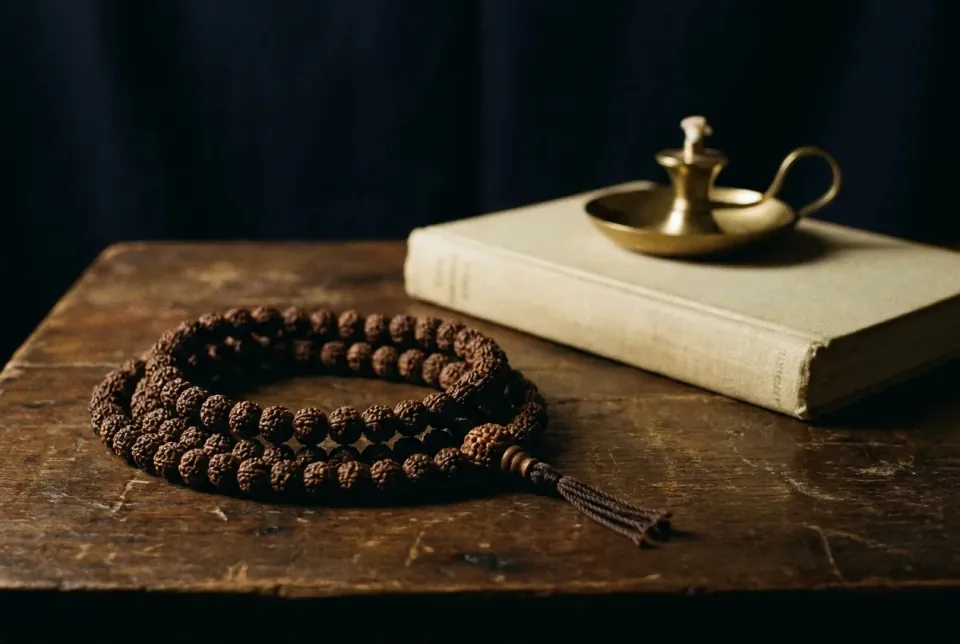
The beads do not sparkle. Their surfaces are furrowed like small weathered planets. That plainness is part of their force. Gold can announce rank, and a gemstone can catch a room’s light. A rudraksha points elsewhere: toward the tree, the hand and the repeated name of Shiva.
It is tempting to call rudraksha the oldest spiritual jewelry still worn. The material record supports a more careful sentence. Rudraksha belongs to a long, living family of South Asian devotional objects, and museum collections show it crossing regions and religious settings. Its sacred history is older than any bead a seller can date by sight. This article follows the seed through those distinct layers: plant, Shaiva story, mala, modern market and daily care.
A blue fruit with a hard center
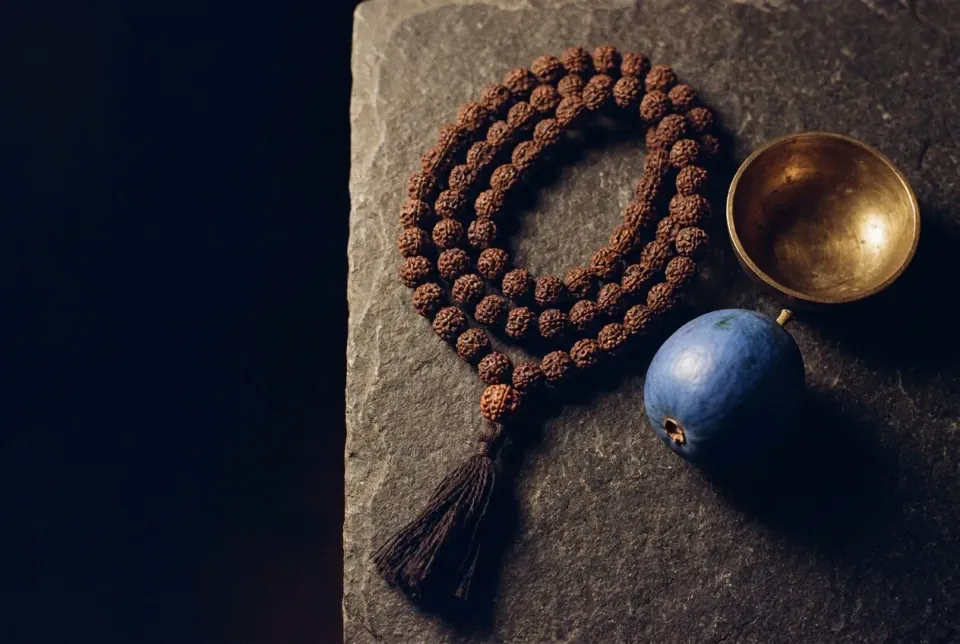
A rudraksha bead is not a carved wooden sphere. It is the hard inner stone, or endocarp, of a fruit produced by trees in the Elaeocarpus group. Botanical names have shifted as taxonomists compared specimens. Kew Science currently treats Elaeocarpus ganitrus as a synonym, while botanical and conservation literature also uses E. sphaericus and related names.
A study archived by the US National Library of Medicine describes the rudraksha tree as a tropical evergreen associated with Northeast India and records the seed’s use in malas across Hindu, Sikh and Tibetan Buddhist contexts. The living plant is wider than one devotional use, and the devotional use is wider than one modern shop category.
The fruit can ripen to a vivid blue outside. Remove the flesh and a deeply textured stone remains. Natural lines run lengthwise from one pole toward the other. These divisions are counted as mukhi, or faces. The number belongs to the seed’s growth, not to a symbol painted onto it later.
That physical fact matters because the market often mixes botany, theology and promised outcomes into one claim. A bead can have five natural faces. A Shaiva text or teacher can give five faces a sacred association. Neither fact proves that wearing the bead treats blood pressure, anxiety or another medical condition. Research has examined plant extracts and traditional medicinal uses, but there is not good clinical evidence that a bead worn against the skin cures disease.
Why the seed belongs to Shiva
The name is commonly read through Rudra, an early and enduring name of Shiva, and aksha, often understood here as eye. The English phrase “tear of Shiva” comes from the tradition’s origin story: after a vast meditation, Shiva opens his eyes and tears fall to earth. Rudraksha trees grow where the drops land.
This is sacred narrative, not botanical history. Naming it correctly does not weaken it. The story gives the seed a devotional relation to Shiva’s gaze, compassion and meditation. It explains why a hard stone from a fruit can be received as more than raw material.
Traditional literature does more than tell an origin. Book 11 of the Devi Bhagavatam gives detailed instructions for stringing, consecrating, wearing and counting with rudraksha. It describes a meru bead, directs the practitioner to hold the rosary with devotion and places rudraksha on the head, neck, ears or arms. The prescriptions belong to a particular textual and ritual world. They should not be flattened into a universal rule for every Hindu community.
Visual history shows the association in another register. The Met’s Shiva wears rudraksha while meditating. The British Museum holds a nineteenth-century rosary acquired in Tibet, made with 60 rudraksha seeds, another type of seed and coral. One object does not prove one unbroken custom everywhere. It does show how prayer beads travel, combine materials and enter lives beyond a single neat category.
What the faces mean
A mukhi is first something you can see: a natural division on the bead. Five-faced rudraksha are common in contemporary malas. Scarcer face counts attract more elaborate associations and higher prices.
Religious lists connect different counts with divine forms. Common modern summaries identify one face with Shiva, two with the united form of Shiva and Parvati, three with Agni, four with Brahma, five with a form of Rudra and six with Kartikeya. Longer lists continue through other deities and powers. The exact associations can differ by text, lineage and seller.
That last distinction deserves space. A traditional correspondence is not the same as a guaranteed result. “Associated with Kartikeya” is a religious statement. “Improves memory” or “corrects a planet” is a modern claim that needs its own evidence. A high price does not turn the second sentence into science.
For a person beginning a practice, the face count may matter less than the relationship around it. Was the bead given within a community? Is it part of a mala used for japa, the repetition of a mantra or divine name? Did a teacher give specific guidance? Our feature on Yogananda, mala lineage and japa explains how counting beads serve attention, and why the distinct terminal bead is not crossed during a round.
How genuine beads are judged
Grading starts with condition and natural structure. Look for continuous clefts, a firm surface and a bead free from serious cracks, insect damage or glued sections. A naturally irregular surface is normal. Perfect symmetry is not proof of quality.
The familiar water test is weak evidence. A mature bead may sink, but density varies. A weighted imitation can also sink, while a real bead with an internal void may float. Copper-coin rotation and claims about a bead’s invisible field are not reliable authentication methods either.
For a common five-faced mala, a reputable source, close inspection and a fair return policy may be enough. For a costly rare-face bead, ask who performed the examination and what the report actually confirms. X-ray imaging can reveal internal compartments and detect some joins or fillings, but the image still needs skilled interpretation. A seller’s certificate is not automatically independent.
Also inspect the jewelry construction. Check that drilled holes do not split the poles. Make sure knots protect neighboring beads from rubbing together. Examine the cord where it meets a clasp, tassel or metal cap. A sacred object still obeys material limits. The checks in our guide to choosing spiritual jewelry apply here as firmly as they do to a gemstone necklace.
A mala, a necklace and a sign of belonging
Rudraksha can be worn as a single bead, a bracelet, a neck strand or a full counting mala. These forms overlap, but they are not identical.
A mala is built to move through the fingers. The cord needs a little space, the count needs to remain clear and the terminal bead needs to be recognizable by touch. A necklace is built first for wear. It may use a clasp, metal spacers or a pendant arrangement that would interrupt counting. Our field guide to spiritual necklaces helps separate a wearable symbol from a practice tool without declaring one more sincere than the other.
For Shaiva devotees, rudraksha can also mark belonging. Wearing the seed may recall Shiva, a mantra, a vow or the guidance of a teacher. An outsider can wear rudraksha respectfully, but respect begins with learning what the object is. Do not market it as an exotic charm stripped of Shiva. Do not claim initiation that did not happen. Do not use a rare face count as a status symbol while ignoring the practice the seed is meant to support.
If a temple, teacher or lineage gave you rules, follow that guidance over a general web article. Customs differ on when a mala is worn, whether it is shown publicly and how it is consecrated. Difference here is not a defect. It is evidence that a living tradition has communities rather than one customer manual.
Care for the seed and the cord
Rudraksha is durable, but it is organic. Heat, detergent, perfume, repeated soaking and long damp storage can weaken a bead or its cord. Remove the strand before a hot shower, swimming pool or chemical cleaner. Wipe sweat away with a soft dry cloth. Let a damp strand dry fully in moving air before storing it.
The Isha Life rudraksha guide gives its community a specific conditioning method with ghee and full-fat milk, followed by water and a clean cloth. It also says this treatment protects against brittleness rather than “re-energizing” the bead. Other communities advise light oiling or different care. Follow the instructions of the source that prepared your mala, especially when thread, metal caps or other materials are present.
For ordinary physical maintenance:
- Inspect before cleaning. Look for a frayed cord, opening knot, cracked pole or loose metal cap.
- Keep chemicals away. Remove the strand before using soap, sanitizer, perfume or hair products.
- Clean gently. Use a soft dry brush for dust in the grooves. Do not scrape the faces with a pin.
- Dry completely. After accidental wetting, blot the strand and leave it flat in an airy place.
- Restring before failure. Replace a tired cord while every bead is still present and its order is known.
- Store with care. Lay the mala on clean cloth rather than crushing it under heavier jewelry.
These steps protect the object. A mantra, offering or consecration belongs to the spiritual relationship around it.
Let one bead become a return
Begin without pretending to recover a rite you were never taught. Choose a common rudraksha mala or a single bead from a source you trust. Sit for five minutes. If Om Namah Shivaya belongs within your practice or has been given to you, repeat it once per counting bead. Otherwise use a prayer from your own tradition, or hold the bead silently as a reminder to return.
Do not hurry to finish 108 repetitions. Touch one bead, complete one phrase and move. When attention leaves, let the next rough surface be the place it comes back. If the strand has a meru bead, pause there and reverse direction rather than crossing it.
The museum image remains quiet. Shiva’s rudraksha does not perform for the viewer; it rests against the body of a meditator. That is the seed’s enduring lesson. Its grooves can be counted, graded and sold, but their deepest use is simpler. They give the hand somewhere to return while the mind learns to stay.